


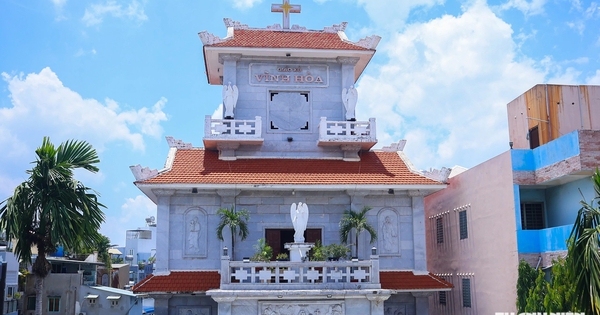
Ho Chi Minh City's hidden stone church blends Eastern architecture with natural stone
Translated from Vietnamese and summarized by DistantNews. Read the original for the full story.
At a glance
In-depth
Sources not specified
Context piece
- The Vinh Hoa stone church in Ho Chi Minh City is notable for its unique architecture, featuring walls entirely clad in natural stone.
- The church, resembling a traditional Vietnamese village communal house, was rebuilt and clad in stone, leading to its common name.
- Construction involved transporting stone from Thanh Hóa province via nearly 100 train journeys and employing skilled artisans from Ninh Bình.
Tucked away in a narrow alley on Ong Ich Khiem Street in Ho Chi Minh City lies the Vinh Hoa stone church, a structure that captivates visitors with its walls of natural stone and distinct Asian architectural style.
Locals often refer to it as the "stone church" due to its unique facade. The Vinh Hoa church comprises three levels, evoking the image of an ancient Vietnamese village communal house. While its foundation, frame, and roof are constructed from reinforced concrete, the exterior walls are meticulously covered with natural stone blocks, lending the building a solemn and ancient ambiance.
Mr. Đỗ Xuân Cảnh, who is responsible for ringing the church bells, noted that while many churches incorporate stone, few achieve the striking presence of Vinh Hoa. He mentioned that the original church, named Vinh Hoa after its location, had deteriorated and could no longer accommodate the growing congregation. Following its reconstruction and the distinctive stone cladding, it became widely known as the Vinh Hoa stone church.
I know many churches are made of stone, but I have never seen one made entirely of stone like this church.
A notable detail on the facade of the highest tower is a stone bas-relief depicting the Đông Sơn bronze drum, framed within a square. According to Mr. Cảnh, this motif symbolizes the traditional Vietnamese concepts of round heaven and square earth, serving as a reminder of national cultural roots.
The stone used for the church was quarried in Thanh Hóa province and transported by rail to Ho Chi Minh City for processing. Many of the foundation and pillar stones weigh several tons. Mr. Cảnh explained that the construction required nearly 100 cargo train trips to bring the necessary materials south, and skilled craftsmen from Ninh Bình were brought in for the work. The process of transporting the stones into the narrow, busy alleyway presented its own challenges, requiring nighttime deliveries and the assistance of local youth to unload the heavy materials.
In the past, the church was named Vinh Hoa after the place name. Later, when it was rebuilt and covered with stone, its name was changed to Vinh Hoa stone church.
About this summary
Originally published by Thanh Niên in Vietnamese. Translated, summarized, and contextualized automatically by DistantNews, with a note on how the source frames the story. Not individually reviewed before publishing. How this works.
More Stories


From Our Blog

What Gets Lost (and Found) When News Is Translated

The Critical Role of Diaspora Media in Global News

What Travellers Should Know About Countries with Restricted Press

A Digital Nomad's Guide to Following Local News

How the Same Story Looks Different in Different Countries
