


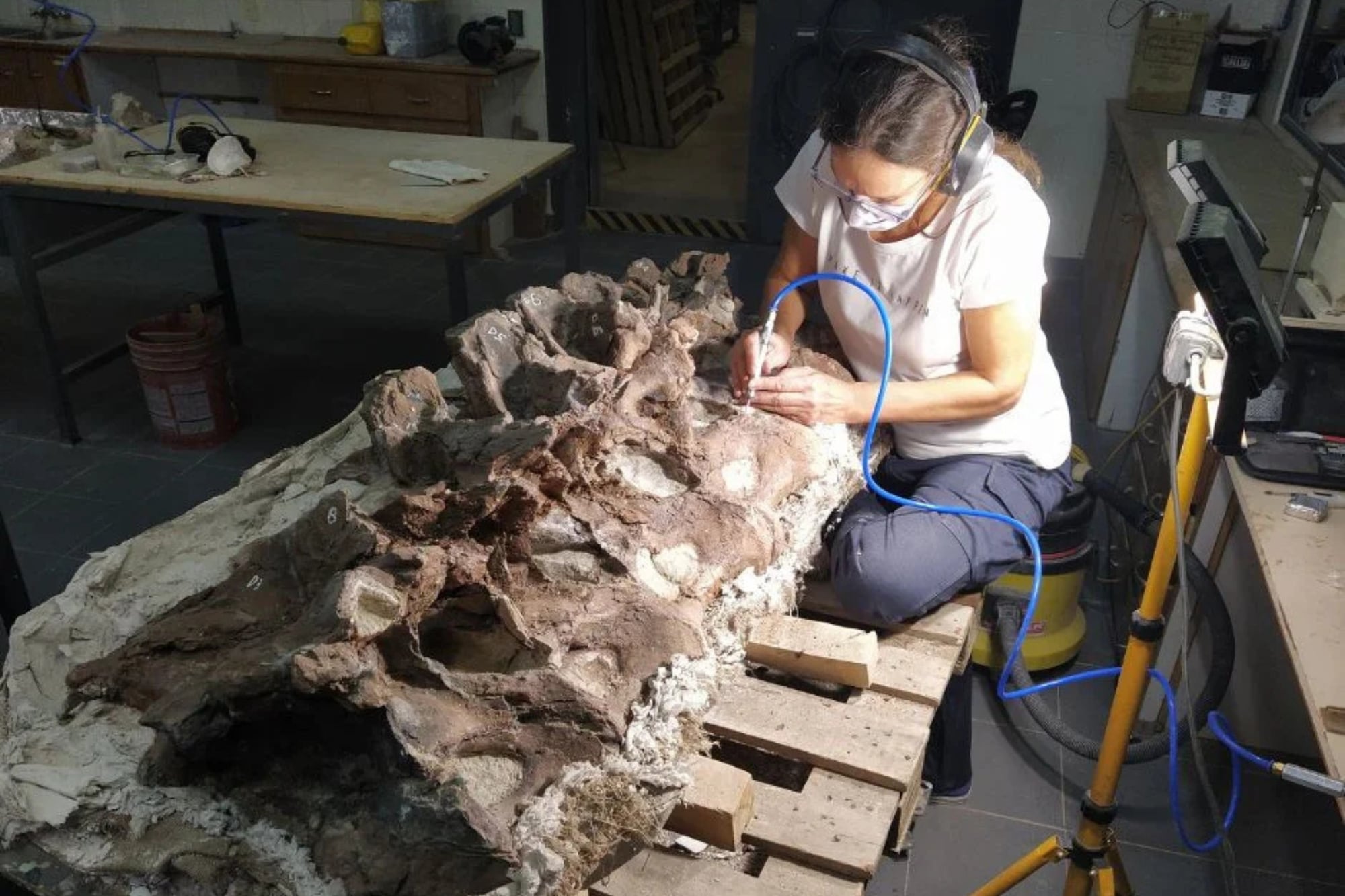
Horseback Rider in Argentina Discovers Fossil of New Dinosaur Species Named After Him
Translated from Spanish, summarized and contextualized by DistantNews.
TLDR
- A resident of Chubut, Argentina, discovered fossilized remains of a new dinosaur species while riding his horse.
- The herbivore, named Bicharracosaurus dionidei, lived in the Patagonian region 160 million years ago during the Jurassic period.
- The discovery highlights Argentina's rich paleontological heritage and the importance of local contributions to science.
In the vast, windswept plains of Chubut, Argentina, a remarkable discovery has once again placed our nation at the forefront of paleontological exploration. Dionide Mesa, a local resident whose keen eye and lifelong connection to the land led him to this incredible find, embodies the spirit of discovery that thrives in Patagonia.
His habit of reporting unusual findings to the Egidio Feruglio Paleontological Museum (MEF) has now immortalized him, with the newly identified dinosaur bearing his name: Bicharracosaurus dionidei. This long-necked herbivore, dating back 160 million years to the Jurassic period, roamed a landmass on the cusp of fragmentation, a testament to the ancient world that once existed here.
Dionide lives alone and moves on horseback through the field. Every time he found fossils, he would notify us and say: 'I found a big one!', and he would take us to the place. Sometimes he spoke of a 'rib cage', and we ended up finding vertebrae with associated ribs.
This discovery is more than just adding another name to the dinosaur registry; it underscores Argentina's status as a global hotspot for Jurassic-era fossils. The Cañadón Calcáreo Formation in Chubut is internationally recognized for its unparalleled collection of Gondwanan remains. The MEF, in collaboration with CONICET and international partners, continues to unearth the secrets of our prehistoric past, reminding us of the deep history embedded in our soil.
What makes this find particularly special from an Argentine perspective is the direct involvement of a local citizen. While international media might focus on the scientific classification and evolutionary significance, for us, it's also a story of a man, his horse, and the land he knows intimately. It’s a reminder that scientific breakthroughs often begin with curiosity and a connection to the natural world, right in our own backyard. This is not just science; it's a celebration of local knowledge and its invaluable contribution to our understanding of Earth's history.
The most distinctive feature is its neural spines — the bony projections on the vertebrae. While in most sauropods they are wider than they are long, in this dinosaur they are compressed and elongated from front to back.
DistantNews Editorial
Originally published by La Nación in Spanish. Translated, summarized, and contextualized by our editorial team with added local perspective. Read our editorial standards.
More Stories


From Our Blog

What Gets Lost (and Found) When News Is Translated

The Critical Role of Diaspora Media in Global News

What Travellers Should Know About Countries with Restricted Press

A Digital Nomad's Guide to Following Local News

How the Same Story Looks Different in Different Countries
