


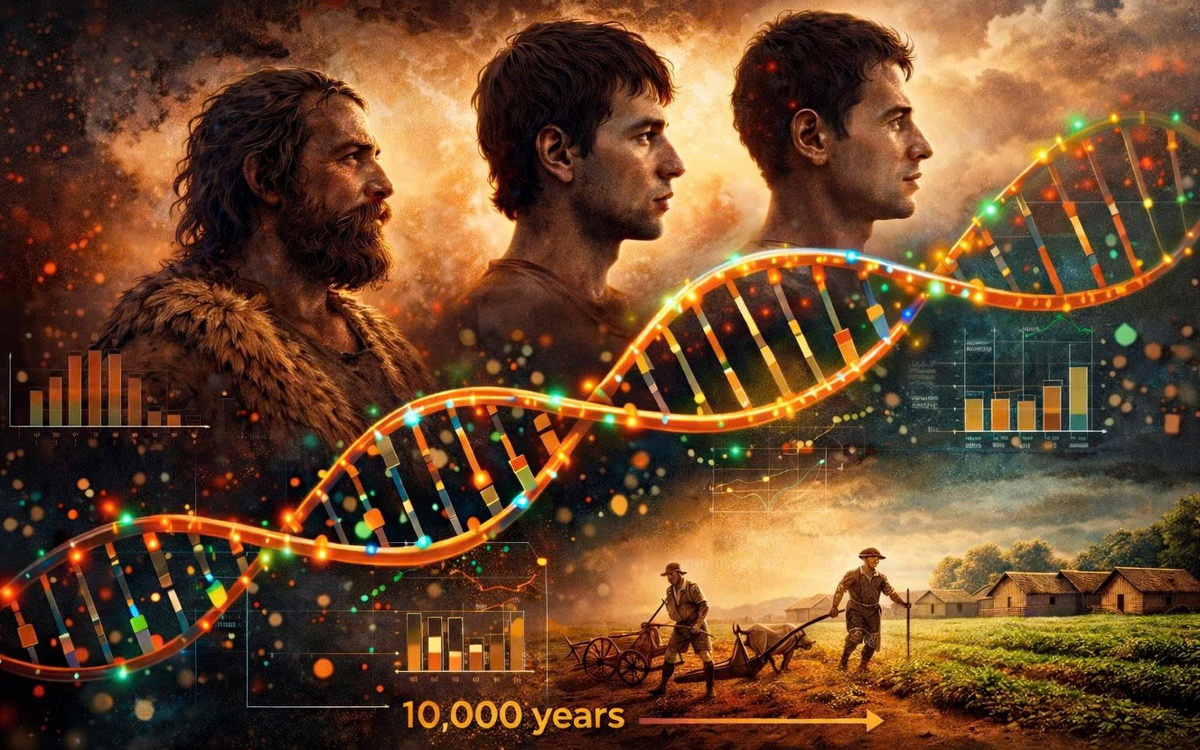
Human Evolution Accelerates, Blood Type B Dominates A
Translated from Vietnamese, summarized and contextualized by DistantNews.
TLDR
- A new study analyzing ancient DNA reveals that human evolution has accelerated significantly in recent millennia, contrary to previous beliefs.
- Natural selection has profoundly impacted the human genome, influencing traits like skin color, blood type, and immunity.
- The shift to agriculture played a key role in this acceleration, introducing new environmental pressures that favored specific genetic adaptations.
Tuổi Trẻ reports on a groundbreaking study from Harvard University that reshapes our understanding of human evolution. The research, based on an unprecedented analysis of ancient DNA from Western Eurasia, indicates that natural selection has been a far more active force in shaping the human genome than previously thought, particularly in the last 10,000 years.
The study's findings challenge the long-held notion that recent human evolution was a slow process. By examining genetic data from nearly 16,000 ancient individuals, scientists have identified hundreds of gene variants that have undergone strong natural selection. This suggests that adaptations related to immunity, metabolism, and even physical traits like skin and hair color have evolved more rapidly in response to changing environments and lifestyles.
From a Vietnamese perspective, this research underscores the dynamic nature of human development and the intricate relationship between our biology and environment. The article highlights how the transition to agriculture, a pivotal moment in human history, introduced new selective pressures, such as increased population density and closer contact with domesticated animals, which spurred significant genetic changes. This scientific insight offers a deeper appreciation for the evolutionary journey that has led to the diverse human populations we see today, emphasizing that evolution is an ongoing, adaptive process.
DistantNews Editorial
Originally published by Tuổi Trẻ in Vietnamese. Translated, summarized, and contextualized by our editorial team with added local perspective. Read our editorial standards.
More Stories


From Our Blog

What Gets Lost (and Found) When News Is Translated

The Critical Role of Diaspora Media in Global News

What Travellers Should Know About Countries with Restricted Press

A Digital Nomad's Guide to Following Local News

How the Same Story Looks Different in Different Countries
