

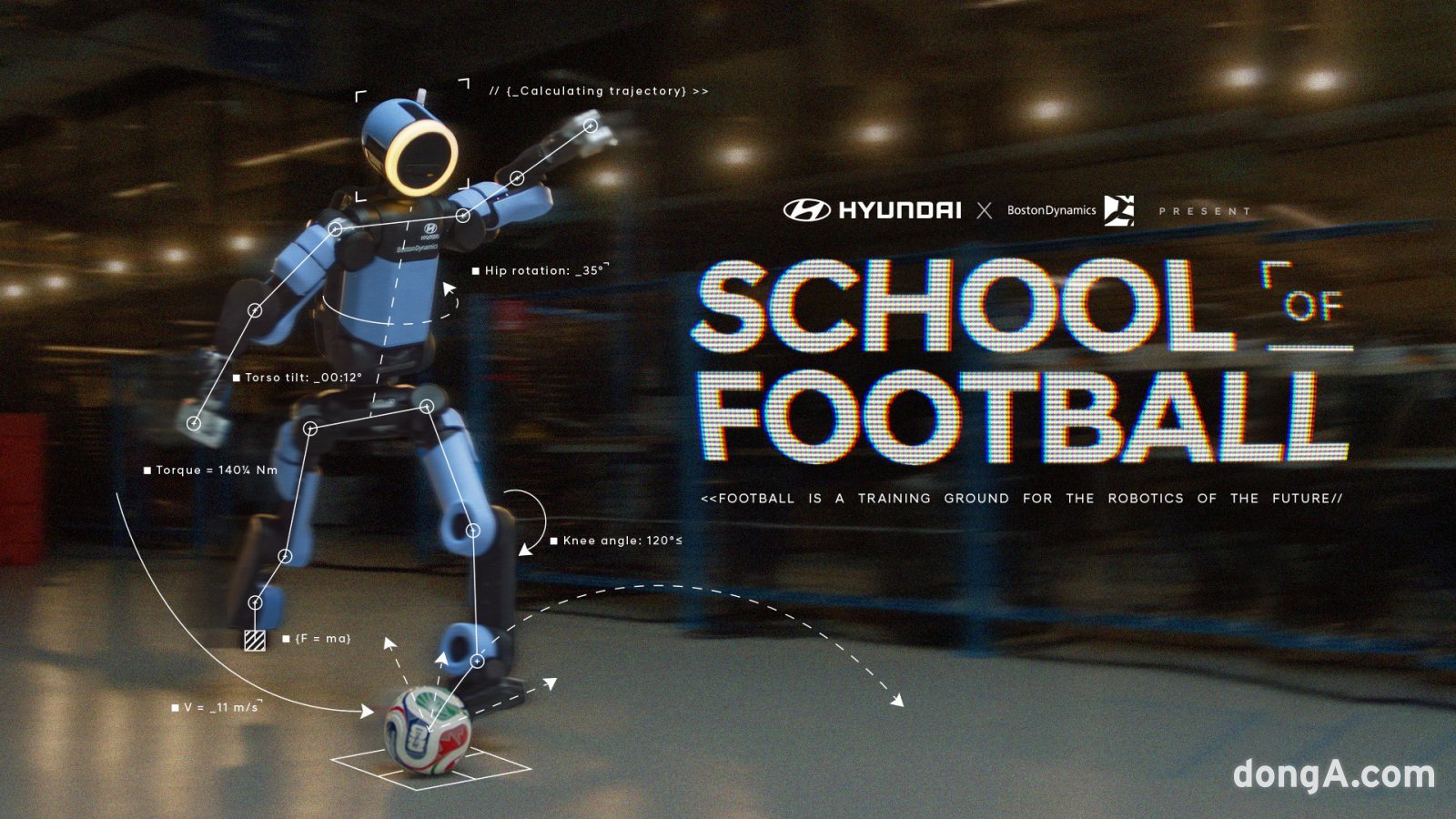
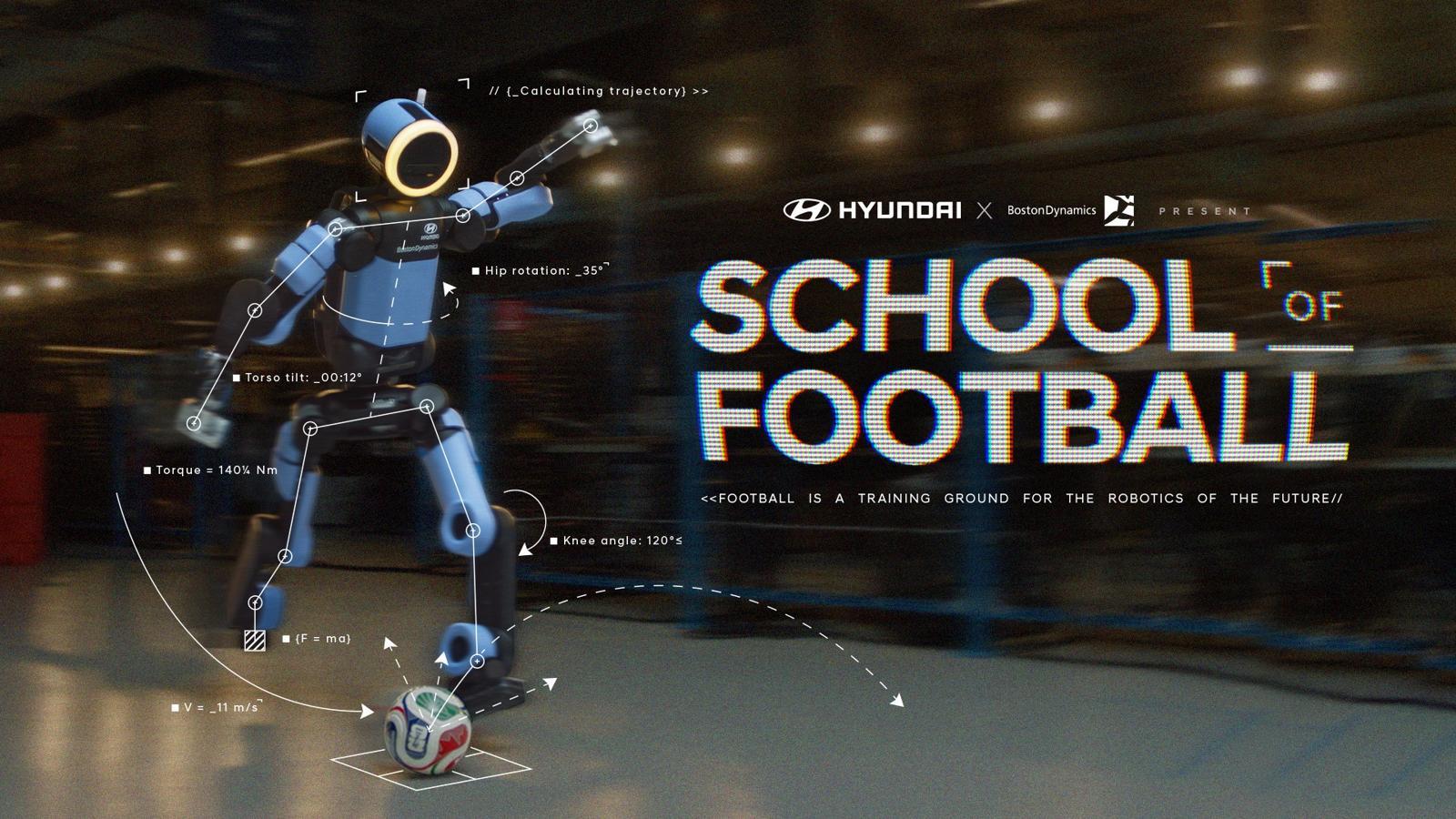
Hyundai's Atlas Robot Masters Soccer Skills, Learns a Year's Worth of Training in 24 Hours
Translated from Korean, summarized and contextualized by DistantNews.
At a glance
News
Named sources
Context piece
- Hyundai Motor Group released a video showcasing its Atlas humanoid robot training for soccer.
- The robot successfully performed various soccer techniques, including a complex "ghost rabona kick," demonstrating advanced balance and coordination.
- Through AI-powered simulations, Atlas learned complex movements equivalent to one year of human training in just 24 hours.
Hyundai Motor Group has unveiled a video demonstrating the advanced soccer training of its Atlas humanoid robot, developed by Boston Dynamics. The company chose soccer, a sport demanding intricate balance and coordination, to showcase the robot's fluid and natural movement capabilities.
The Atlas robot executed fundamental soccer actions like passing and shooting, culminating in a complex maneuver known as the "ghost rabona kick." This advanced technique involves a feint to deceive opponents before striking the ball. Researchers at Boston Dynamics identified soccer as an ideal environment for refining humanoid robot technology, as it engages multiple physical capabilities simultaneously.
According to the research team, kicking drills help the robot develop timing, power generation, and coordination. More complex movements further enhance its rotational control, weight transfer, and overall body control. The training program was designed by referencing the biomechanics and movement patterns of human soccer players.
Using a motion capture system, player movements were recorded and then adapted to the robot's joint structure through a process called "retargeting." Artificial intelligence and reinforcement learning were then applied, enabling Atlas to optimize its balance and power delivery independently. This accelerated learning process, conducted through thousands of simultaneous simulations on cloud GPUs, allowed Atlas to acquire complex movements in just 24 hours, equivalent to approximately one year of human trial and error.
For example, through kicking movements, one can learn timing, power generation, and coordination, and through more complex movements, one can develop rotational motion, weight transfer, and whole-body control capabilities.
DistantNews Editorial
Originally published by Dong-A Ilbo in Korean. Translated, summarized, and contextualized by our editorial team with added local perspective. Read our editorial standards.
More Stories


From Our Blog

What Gets Lost (and Found) When News Is Translated

The Critical Role of Diaspora Media in Global News

What Travellers Should Know About Countries with Restricted Press

A Digital Nomad's Guide to Following Local News

How the Same Story Looks Different in Different Countries
