


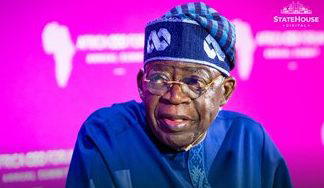
IMF, President Tinubu and the transparency challenge
Summarized and contextualized by DistantNews.
At a glance
Analysis
Named sources
Context piece
- The article criticizes Nigerian President Bola Ahmed Tinubu's administration for alleged "theft" of public funds, citing IMF and Senate reports.
- An IMF report indicated that 2% of Nigeria's GDP in public spending is not accounted for in official budgets.
- A Senate committee uncovered N210 trillion in discrepancies within the NNPC between 2017 and 2023, raising serious concerns about financial mismanagement.
Nigeria's rulers have a history of treating the national treasury as a personal inheritance, a practice that appears to have reached a "fullest flowering" under President Bola Ahmed Tinubu's administration. This critique comes from Moshood Oshunfurewa, who invokes the spirit of the late human rights lawyer Gani Fawehinmi to condemn the current financial situation as "organized, institutionalized, defended-in-law theft of the commonwealth."
Let us call this what it is. Not ‘fiscal opacity.’ Not ‘off-budget spending.’ Not the polite, bloodless language of the International Monetary Fund. What is happening in Nigeria under Bola Ahmed Tinubu is theft, organized, institutionalized, defended-in-law theft of the commonwealth, executed by a ruling class that has learned to dress looting in the language of governance.
The International Monetary Fund (IMF) has pointed to a significant financial gap, with its man in Abuja, Christian Ebeke, noting in July 2026 that approximately 2% of Nigeria's GDP in public spending simply vanishes from official budget documents. The article argues that this "off-budget spending" is not a technical footnote but a "declaration of war on the Nigerian people," impacting essential services like healthcare, education, and infrastructure.
The IMF's report described these issues using euphemisms like "off-budget spending and complex financing instruments." However, the author contends that such language is a smokescreen used by those engaged in illicit activities. The masses, it is argued, understand the reality of hunger and empty pots, not the jargon of financial instruments.
Two percent of GDP is not small change, it is hospitals unbuilt, teachers unpaid, roads that kill commuters, and children who will never see a classroom. It is the difference between a nation that can feed its people and one that cannot.
Further compounding these concerns is the revelation by the Senate Committee on Public Accounts, under Ahmed Wadada, of N210 trillion in discrepancies within the Nigerian National Petroleum Corporation (NNPC) between 2017 and 2023. These funds are unaccounted for under categories like "unsubstantiated accrued expenses" and "receivables." The article posits that this is not mere incompetence but a deliberate system designed to funnel the nation's oil wealth into private hands, with officials expressing surprise at the system's effectiveness while the country suffers.
This is not incompetence. Incompetence does not produce numbers this precise in their imprecision. This is a system functioning exactly as its architects designed it: a machine for converting the nation’s oil wealth into private fortune while the mechanics who built the machine call press conferences to express shock at how well it works.
DistantNews Editorial
Originally published by Vanguard. Summarized and contextualized by our editorial team with added local perspective. Read our editorial standards.
More Stories


From Our Blog

How the Same Story Looks Different in Different Countries

What Gets Lost (and Found) When News Is Translated

The Critical Role of Diaspora Media in Global News

What Travellers Should Know About Countries with Restricted Press

A Digital Nomad's Guide to Following Local News
