


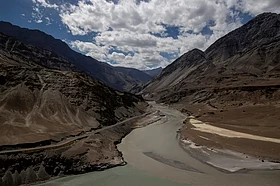
India rejects tribunal ruling on water treaty with Pakistan
Translated from English and summarized by DistantNews. Read the original for the full story.
At a glance
News
Official statement
Ongoing story
- India rejected a Permanent Court of Arbitration ruling that the Indus Waters Treaty remains fully in force and governs its hydroelectric projects on rivers shared with Pakistan.
- The court said India had not justified suspending the treaty and must comply with restrictions on projects including the Ratle plant.
- A World Bank-appointed neutral expert is expected to assess the Himalayan projects by July 2027.
India has rejected an international tribunal’s decision that it must continue observing a decades-old water-sharing treaty with Pakistan, declaring that the ruling will have no effect on its projects.
The Permanent Court of Arbitration said unanimously that none of India’s stated grounds for suspending the Indus Waters Treaty were justified. The agreement, which governs the Indus and associated rivers, remains fully in force, the court said.
The tribunal said India must comply with treaty requirements covering the design and operation of hydroelectric projects on the Western Rivers. It also ruled that India could not build the dam wall and power intake structure at the Ratle hydroelectric plant above specified levels until 90 days after a neutral expert issues a decision.
India must observe its obligations under the treaty, including those relating to the design and operation of its hydroelectric projects on the Western Rivers.
The expert, appointed by the World Bank, is due to determine by July 2027 whether construction of the plants in the Himalayan region complies with the treaty. Pakistan pursued the legal action after India began work to increase reservoir capacity at two hydroelectric projects in Kashmir.
India’s Foreign Ministry said New Delhi did not recognise the court’s authority, despite India officially being a member. “This so-called Court of Arbitration has no jurisdiction whatsoever to pronounce on India's sovereign decisions,” the ministry said, adding that its present and future pronouncements would not affect India’s actions. The treaty has been honoured by both countries since 1960, despite three wars and other conflicts.
This so-called Court of Arbitration has no jurisdiction whatsoever to pronounce on India's sovereign decisions.
About this summary
Originally published by Khaleej Times in English. Translated, summarized, and contextualized automatically by DistantNews, with a note on how the source frames the story. Not individually reviewed before publishing. How this works.
More Stories

From Our Blog

What Gets Lost (and Found) When News Is Translated

The Critical Role of Diaspora Media in Global News

What Travellers Should Know About Countries with Restricted Press

A Digital Nomad's Guide to Following Local News

How the Same Story Looks Different in Different Countries
