


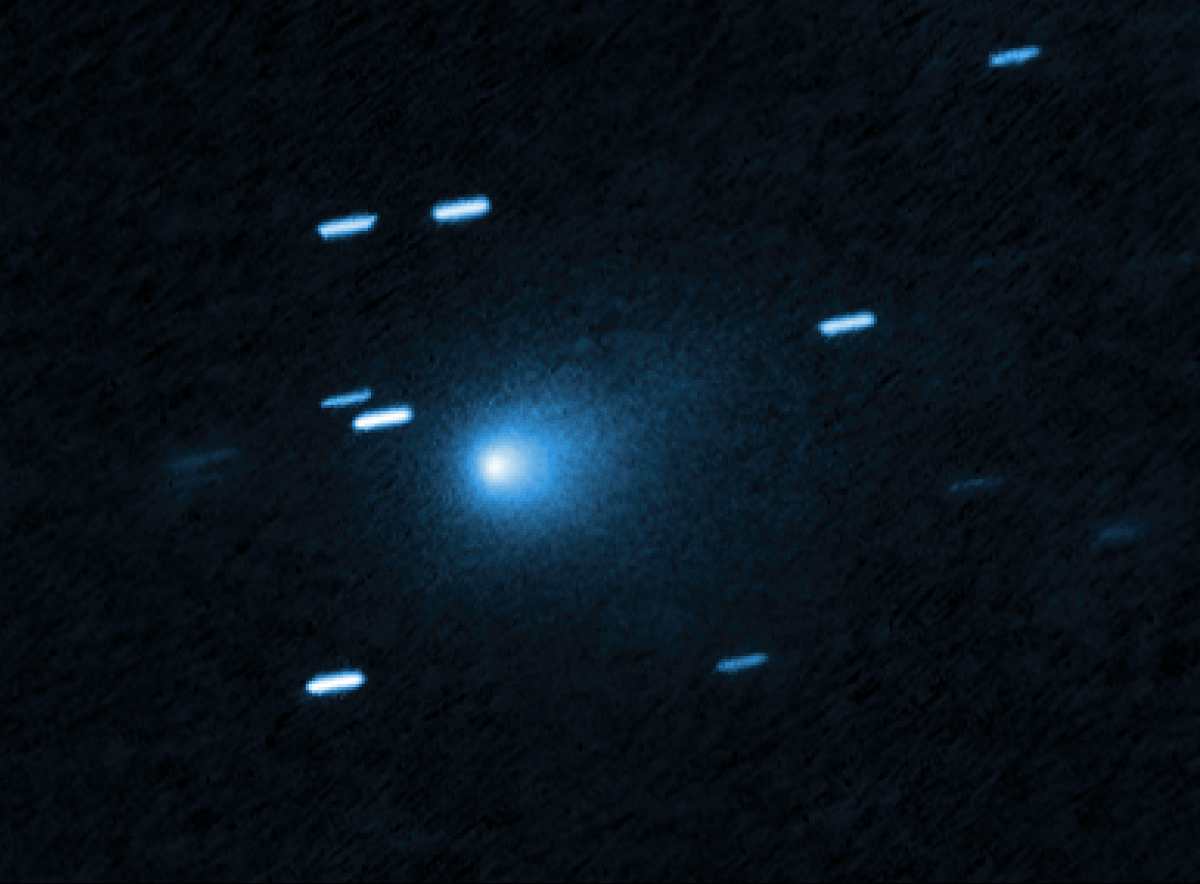
Interstellar Comet 3I/ATLAS's Chemical Fingerprint May Reveal It's Older Than the Sun
Translated from Spanish, summarized and contextualized by DistantNews.
At a glance
News
Named sources
Context piece
- Scientists are analyzing interstellar comet 3I/ATLAS to determine its origin and potential age, with some suggesting it could be older than the Sun.
- The comet's chemical signature, observed by the Very Large Telescope, is being studied to measure isotopic proportions and understand its formation.
- Discovered by the ATLAS telescope, 3I/ATLAS is the third confirmed interstellar object and travels on a hyperbolic trajectory, indicating it was ejected from another star system.
The scientific community is intensely studying the interstellar comet 3I/ATLAS, seeking to unravel its origins and characteristics. Early analyses suggest this celestial visitor might predate our own Sun, a possibility that has spurred significant research into its chemical makeup and journey through space.
Initial observations of 3I/ATLAS, first detected by the ATLAS telescope in Chile on July 1, 2025, indicate it is the third confirmed interstellar object. Its trajectory is hyperbolic, meaning it moves too rapidly to be captured by the Sun's gravity, confirming its origin outside our solar system. The comet exhibits typical features, including an icy nucleus surrounded by a gas and dust cloud that brightens as it approaches the Sun.
Researchers are particularly focused on the comet's chemical signature. Using the Very Large Telescope (VLT) at the European Southern Observatory, scientists have measured the isotopic proportions of carbon and nitrogen within the comet's cyanide molecules. These measurements are crucial for understanding the conditions under which 3I/ATLAS formed in its home star system, potentially billions of years ago.
According to NASA, 3I/ATLAS was likely ejected from another stellar system and wandered through interstellar space for eons before entering our solar system. The detailed analysis of its chemical composition could provide unprecedented insights into the diversity of planetary formation across the galaxy and the age of objects originating from beyond our cosmic neighborhood.
DistantNews Editorial
Originally published by Prensa Libre in Spanish. Translated, summarized, and contextualized by our editorial team with added local perspective. Read our editorial standards.
More Stories



From Our Blog

What Gets Lost (and Found) When News Is Translated

The Critical Role of Diaspora Media in Global News

What Travellers Should Know About Countries with Restricted Press

A Digital Nomad's Guide to Following Local News

How the Same Story Looks Different in Different Countries
