


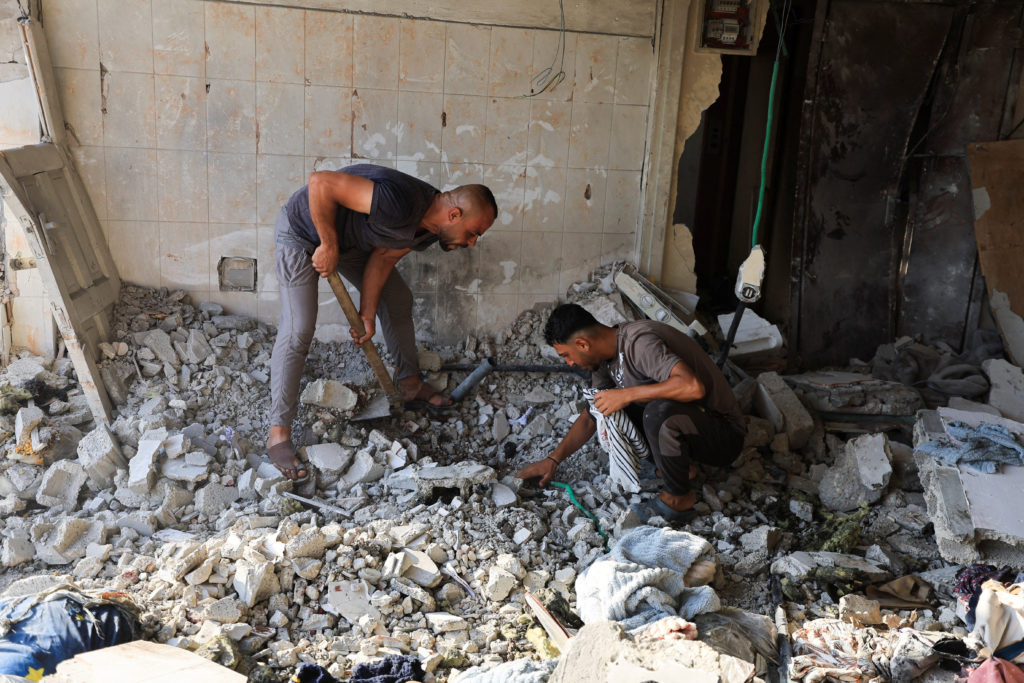
Israel raises 'serious security concerns' with White House over Hamas disarmament deal
Translated from English, summarized and contextualized by DistantNews.
At a glance
News
Named sources
Ongoing story
- Israel has conveyed "serious security concerns" to the White House regarding the proposed Hamas disarmament deal.
- An Israeli official stated that Hamas appears committed to rebuilding its military rather than demilitarizing.
- Israel insists it will not withdraw from Gaza until Hamas physically surrenders its weapons.
Israel has expressed "serious security concerns" to the White House concerning the proposed deal for Hamas to disarm, according to an Israeli official. These comments mark some of the first public remarks since U.S. President Donald Trump announced the agreement.
Doron Spielman, spokesperson for the Israeli Prime Minister's office, told The Associated Press that Israel's intelligence assessment indicates Hamas intends to rebuild its military capabilities rather than genuinely demilitarize. He stressed that the Israeli military would not withdraw from Gaza, a territory where it controls over 60% of the land, until Hamas disarms.
"Our assessment is that if we redeploy before Hamas is truly disarmed, it will quickly expand its presence throughout Gaza, rebuild its terrorist infrastructure, once again threaten Israeli communities, and seek to carry out another Oct. 7-style attack," Spielman stated, referencing the Hamas militant attack on Israel in 2023 that initiated the current conflict.
Our assessment is that if we redeploy before Hamas is truly disarmed, it will quickly expand its presence throughout Gaza, rebuild its terrorist infrastructure, once again threaten Israeli communities, and seek to carry out another Oct. 7-style attack.
He clarified that "disarming means physically giving up the weapons. Nothing less." His remarks come days after Hamas announced it would begin disarming as part of a U.S.-brokered ceasefire signed nine months prior, intended to end the nearly three-year-long conflict. This development presents a potential breakthrough, though numerous obstacles, conditions, and lengthy timelines remain.
Hamas has agreed to disarm, but the process is reportedly fraught with difficulties. Trump's 20-point ceasefire plan includes the militant group surrendering its weapons and destroying its extensive tunnel network. The plan also envisions Israeli forces withdrawing from Gaza, the establishment of a new technocratic Palestinian government, the deployment of an international security force, and the reconstruction of the devastated Palestinian enclave. Hamas's disarmament has been a persistent sticking point, deadlocking negotiations for months.
Trump announced the deal on social media, stating it would be implemented in "carefully structured phases." A copy of the agreement obtained by the AP details that all weapons held by the Hamas-run police would be transferred to the U.S.-backed Palestinian technocratic committee, known as the National Committee for the Administration of Gaza, upon its arrival in the enclave. The timeline for this transfer remains unclear, as it is contingent on other steps. A process to decommission and store heavy weapons, and to dismantle military production sites and tunnels, is set to begin after the Palestinian committee arrives and international forces are deployed. This process will be linked to a phased Israeli withdrawal, according to the agreement. The areas currently under Israeli control in Gaza have been largely destroyed and depopulated, with most of the territory's 2 million Palestinians residing in other areas.
Disarming means physically giving up the weapons. Nothing less.
DistantNews Editorial
Originally published by PBS NewsHour in English. Translated, summarized, and contextualized by our editorial team with added local perspective. Read our editorial standards.
More Stories


From Our Blog

How the Same Story Looks Different in Different Countries

What Gets Lost (and Found) When News Is Translated

The Critical Role of Diaspora Media in Global News

What Travellers Should Know About Countries with Restricted Press

A Digital Nomad's Guide to Following Local News
