

Izmir Bay Cleanup Yields Surprising Debris
Translated from Turkish, summarized and contextualized by DistantNews.
At a glance
News
Named sources
Outcome reported
- Municipal teams conducted a cleanup in Izmir's Bostanlı Fish Port for World Environment Day.
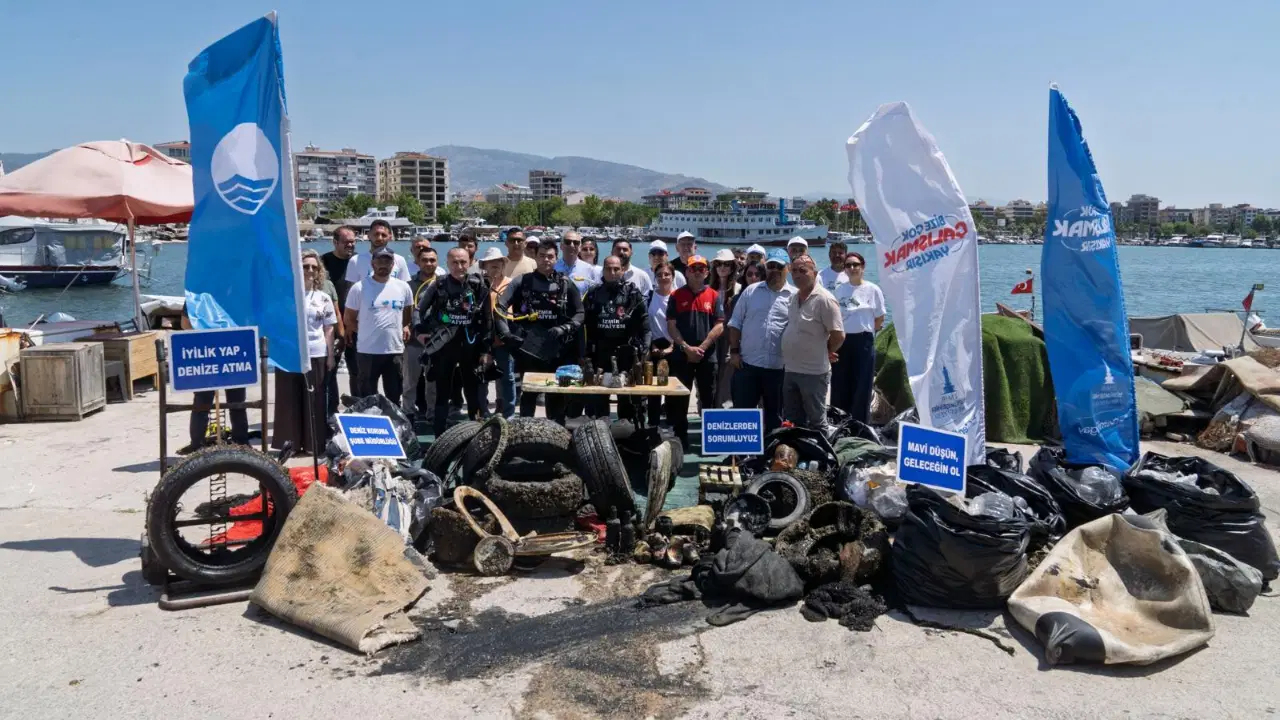
- Divers retrieved car tires, glass bottles, a toilet seat, and other debris from the seabed.
- Officials stressed the importance of preventing pollution, noting that 1,100 tons of solid waste are collected annually.
Municipal teams in Izmir, Turkey, conducted a cleanup operation at the Bostanlı Fish Port as part of World Environment Day and Environment Week activities. The operation, involving the Izmir Metropolitan Municipality's Environmental Protection and Control Department and its Underwater Search and Rescue Team, focused on the seabed and shoreline.
The best way to clean is never to pollute.
Approximately 600 meters of area were cleaned at a depth of about 5 meters. Divers retrieved a variety of waste, including car tires, numerous glass bottles, a table, chairs, and even a toilet seat. The collected waste was sent to recycling facilities.
We did seabed and shoreline cleaning. The sight we saw broke our hearts. All the waste we took out of the sea should be in trash containers.
Saygın Yörük, a regional official from the Izmir Metropolitan Municipality's Marine Protection Branch, emphasized that the primary goal of these efforts is to foster environmental awareness. He highlighted that marine pollution is a global issue, with an estimated 675 tons of trash entering the seas every hour, forming a "seventh continent" of floating debris. "The best way to clean is never to pollute," Yörük stated, urging continuous environmental responsibility beyond just Environment Week.
We have responsibilities that fall on all of us. Marine pollution is a global problem. An average of 675 tons of garbage reaches the seas in one hour. When you gather the garbage floating freely in the sea, an area the size of the seventh continent is formed. Therefore, we need to be very careful.
Efe Eke, one of the divers, described the underwater scene as heartbreaking. "We did seabed and shoreline cleaning. The sight we saw broke our hearts," he said. "All the waste we took out of the sea should be in trash containers." Eke also noted the presence of fishing nets and "ghost nets" that are difficult to remove and harmful to marine life.
As a directorate, we collect an average of 1,100 tons of solid waste annually. However, the best way to clean is never to pollute. Our aim is to increase this awareness. We must be sensitive about keeping our nature and our world clean, not just during environment week, but always. We must come to the shores before we come to the brink of disaster.
DistantNews Editorial
Originally published by Cumhuriyet in Turkish. Translated, summarized, and contextualized by our editorial team with added local perspective. Read our editorial standards.
More Stories


From Our Blog

What Gets Lost (and Found) When News Is Translated

The Critical Role of Diaspora Media in Global News

What Travellers Should Know About Countries with Restricted Press

A Digital Nomad's Guide to Following Local News

How the Same Story Looks Different in Different Countries
