


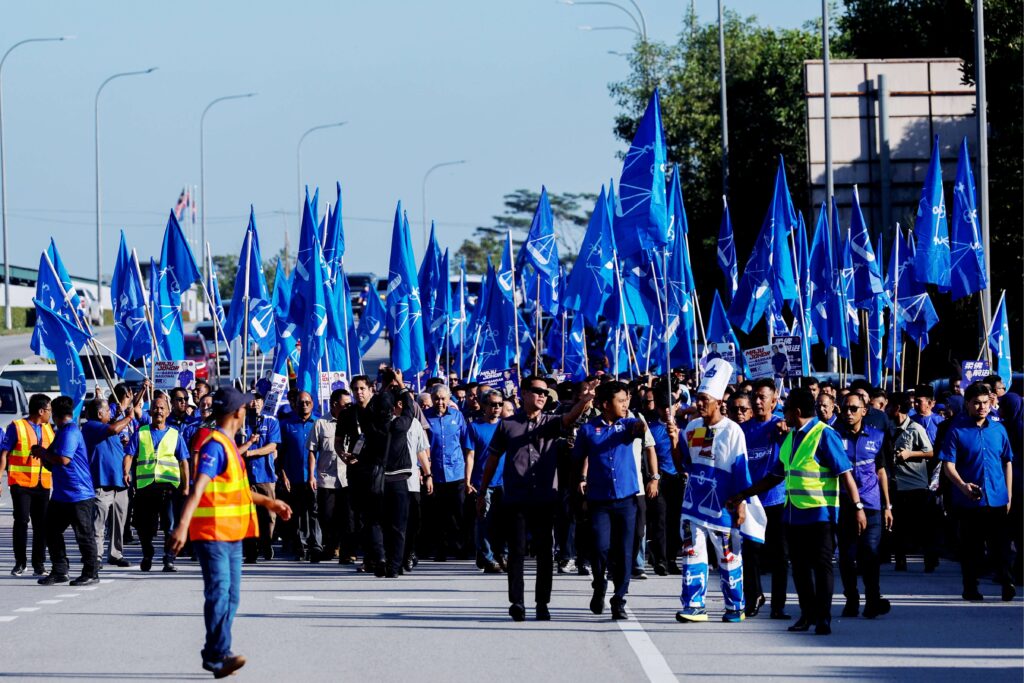
Johor polls: National referendum and the survival of political coalitions
Translated from Malay, summarized and contextualized by DistantNews.
At a glance
Analysis
Sources not specified
Context piece
- The Johor state election has officially begun, drawing national political attention following Malaysia's recent general election shifts.
- Analysts view the Johor election as a national referendum, testing the strength of the ruling unity government's coalition parties.
- Barisan Nasional aims to maintain its dominance, while Pakatan Harapan focuses on defending urban strongholds, and Perikatan Nasional seeks to capitalize on the evolving political landscape.
The 16th Johor state election has officially commenced, transforming the southern Malaysian state into a focal point of national political gravity. This election is particularly significant in the wake of the 15th General Election (PRU15), which dramatically reshaped Malaysia's conventional political narrative and introduced a complex federal unity government.
Many analysts are interpreting the Johor polls as a national referendum, with the outcomes expected to reverberate in Putrajaya and serve as an early gauge of the strength of the three major political blocs: Barisan Nasional (BN), Pakatan Harapan (PH), and Perikatan Nasional (PN). For BN, the incumbent coalition, the mission extends beyond regaining power; it's about solidifying its dominance without showing any signs of weakness. They are campaigning on the state's economic development and high-impact projects like the Johor-Singapore Special Economic Zone (JS-SEZ) to appeal to urban voters and the corporate sector.
However, BN faces internal coordination challenges, particularly concerning candidate selection, which could potentially undermine their support base in rural areas. Meanwhile, PH is adopting a more pragmatic defensive strategy, focusing on retaining its urban and semi-urban strongholds like Johor Bahru and Iskandar Puteri. Their success hinges on maintaining the loyalty of the middle class and young voters, and ensuring seamless cooperation among component parties like PKR and DAP.
Perikatan Nasional (PN) is also vying for influence in this dynamic political landscape. The election is seen as a crucial test for the ruling coalition's stability and a preview of the political alignments leading up to future state elections and the next general election. The outcome in Johor is expected to set the tone for Malaysia's evolving political future, reflecting the complexities of coalition politics and shifting voter demographics.
DistantNews Editorial
Originally published by Utusan Malaysia in Malay. Translated, summarized, and contextualized by our editorial team with added local perspective. Read our editorial standards.
More Stories



From Our Blog

What Gets Lost (and Found) When News Is Translated

The Critical Role of Diaspora Media in Global News

What Travellers Should Know About Countries with Restricted Press

A Digital Nomad's Guide to Following Local News

How the Same Story Looks Different in Different Countries
