


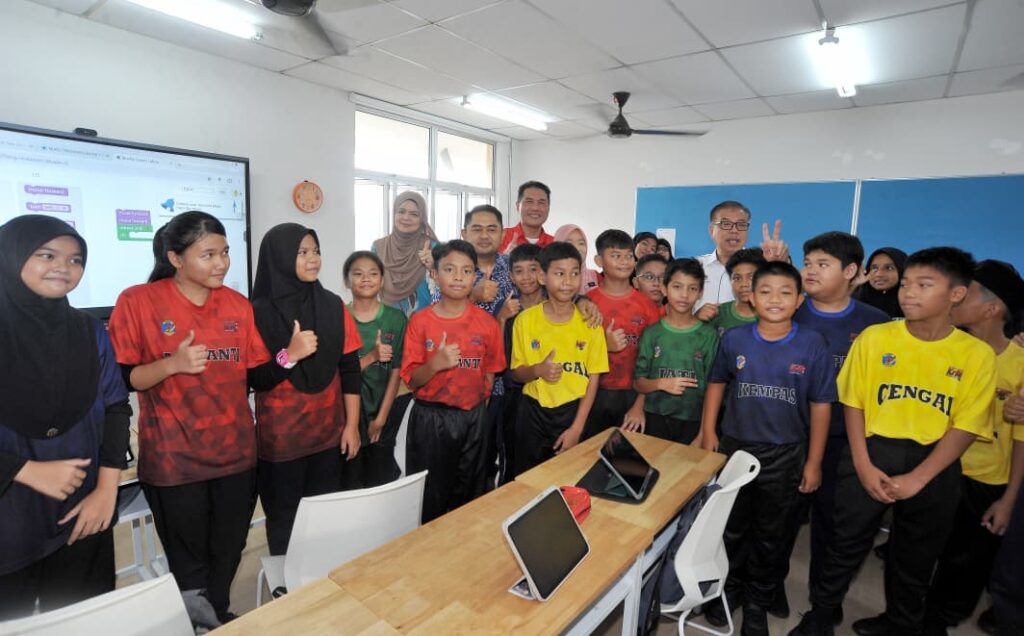
Johor schools to integrate robotics, 3D printing into learning system
Translated from Malay, summarized and contextualized by DistantNews.
At a glance
News
Sources not specified
New plan
- Sekolah Rintis Bangsa Johor (SRBJ) will enhance its learning system with modern technologies like 3D printers, Arduino, and robotics.
- This initiative aims to strengthen the Science, Technology, Engineering, and Mathematics (STEM) education ecosystem and prepare students for Industry 4.0.
- Students from SRBJ schools have already achieved national and international recognition for their innovation projects.
The Sekolah Rintis Bangsa Johor (SRBJ) is set to significantly upgrade its educational framework by integrating advanced technologies. Students will soon benefit from learning systems that incorporate 3D printers, Arduino microcontrollers, robotics, and autonomous systems. This move is designed to bolster the Science, Technology, Engineering, and Mathematics (STEM) education ecosystem within the schools.
The State Government will continue to strengthen the STEM ecosystem through the provision of various learning facilities such as 3D printers, Arduino, robotics, and autonomous systems.
State Education and Information Committee Chairman Dr. Muhammad Naqib Md. Ghazali highlighted that these high-tech facilities are a key focus for ensuring students are well-prepared for the challenges of the Fourth Industrial Revolution and the digital economy. He emphasized that the state government's commitment to enhancing STEM education through such modern learning tools will provide a more interactive and exploratory learning experience.
This initiative aims to provide a more interactive learning experience based on exploration, problem-solving, and innovation development to foster a culture of creative and critical thinking among students.
This initiative is expected to foster a culture of creative and critical thinking among students. The approach emphasizes problem-solving and innovation, moving beyond traditional methods. Dr. Muhammad Naqib pointed out that students from SRBJ schools have already proven their capabilities, earning accolades in national and international innovation competitions. These achievements include a gold medal at SAFEATHON 2026 and the Best Idea Innovation Award at the Japan Youth Summit 2026 for an eco-friendly crayon project.
The use of modern technology in the classroom not only increases students' interest in STEM but also helps shape a culture of creative, critical, and innovative thinking.
Furthermore, SRBJ is forging strategic international collaborations. A partnership with Harvard University through the Program for Scientifically Inspired Leadership (PSIL) is set to offer 100 students exposure to world-class education. These efforts collectively aim to equip students with the skills and mindset needed for future technological advancements and economic landscapes.
SRBJ is also forging strategic collaborations with Harvard University through the Program for Scientifically Inspired Leadership (PSIL), which will benefit 100 students through exposure to international-standard education.
DistantNews Editorial
Originally published by Utusan Malaysia in Malay. Translated, summarized, and contextualized by our editorial team with added local perspective. Read our editorial standards.
More Stories

From Our Blog

What Gets Lost (and Found) When News Is Translated

The Critical Role of Diaspora Media in Global News

What Travellers Should Know About Countries with Restricted Press

A Digital Nomad's Guide to Following Local News

How the Same Story Looks Different in Different Countries
