


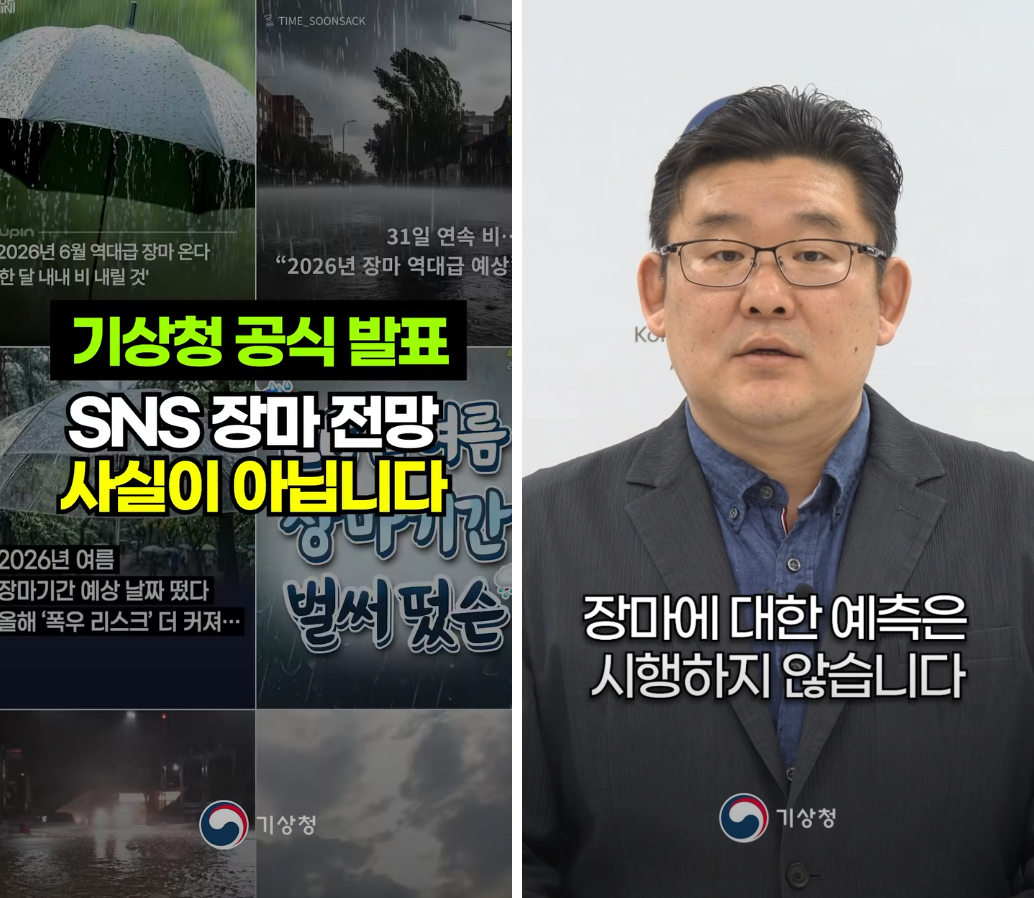
KMA Denies Viral '2026 Rainy Season' Forecasts as Fake News
Translated from Korean, summarized and contextualized by DistantNews.
TLDR
- South Korea's Meteorological Administration (KMA) has debunked viral social media posts predicting a prolonged "2026 rainy season" lasting 31 days.
- The KMA stated that such long-term, specific rainy season forecasts are scientifically difficult and that they have not conducted such predictions since 2009.
- The agency is actively responding to misinformation by commenting on social media posts and directing users to official channels for accurate weather information.
In an era where information, and misinformation, spreads rapidly online, the South Korean Meteorological Administration (KMA) has taken a proactive stance against a viral social media rumor predicting an unusually long rainy season in 2026. Posts circulating widely claimed an "epic rainy season" would bring rain for 31 consecutive days, citing overseas weather models and historical data as evidence. However, the KMA has firmly refuted these claims, labeling them as false information and urging the public to avoid confusion.
It is scientifically difficult to predict the number of rainy days or the amount of precipitation due to the rainy season over a long period.
As a publication based in South Korea, Dong-A Ilbo understands the public's reliance on weather forecasts, especially concerning the monsoon season, which significantly impacts daily life and the economy. The KMA's statement clarifies that predicting the exact start and end of the rainy season, let alone specific durations like 31 days, over such a long period is scientifically challenging. The agency emphasized that since 2009, they have ceased issuing specific rainy season forecasts, instead analyzing and officially announcing the season's parameters after it has concluded. This approach aligns with the scientific realities of meteorological forecasting, which involves inherent uncertainties, particularly for extended periods.
Since 2009, the KMA has not conducted rainy season predictions. The start and end of the rainy season are officially announced through analysis after the summer ends.
The KMA's response goes beyond a simple denial; they are actively engaging with the misinformation by leaving comments on high-visibility social media posts, clearly stating, "This is the KMA. The SNS rainy season forecast is not true. For more details, please check our official channels." This direct engagement is crucial for correcting the record and preventing the spread of inaccurate information. From our perspective, this situation highlights the critical need for media literacy and the importance of relying on official sources for vital information like weather predictions. While international weather apps and models can offer valuable insights, they should not be presented as definitive forecasts, especially when official meteorological agencies have different methodologies and reporting protocols. The KMA's efforts underscore the responsibility of both the agency to communicate clearly and the public to verify information before sharing it.
The KMA is responding actively by leaving comments on posts with high viewership, such as 'This is the KMA. The SNS rainy season forecast is not true. For more details, please check our official channels.'
DistantNews Editorial
Originally published by Dong-A Ilbo in Korean. Translated, summarized, and contextualized by our editorial team with added local perspective. Read our editorial standards.
More Stories


From Our Blog

What Gets Lost (and Found) When News Is Translated

The Critical Role of Diaspora Media in Global News

What Travellers Should Know About Countries with Restricted Press

A Digital Nomad's Guide to Following Local News

How the Same Story Looks Different in Different Countries
