


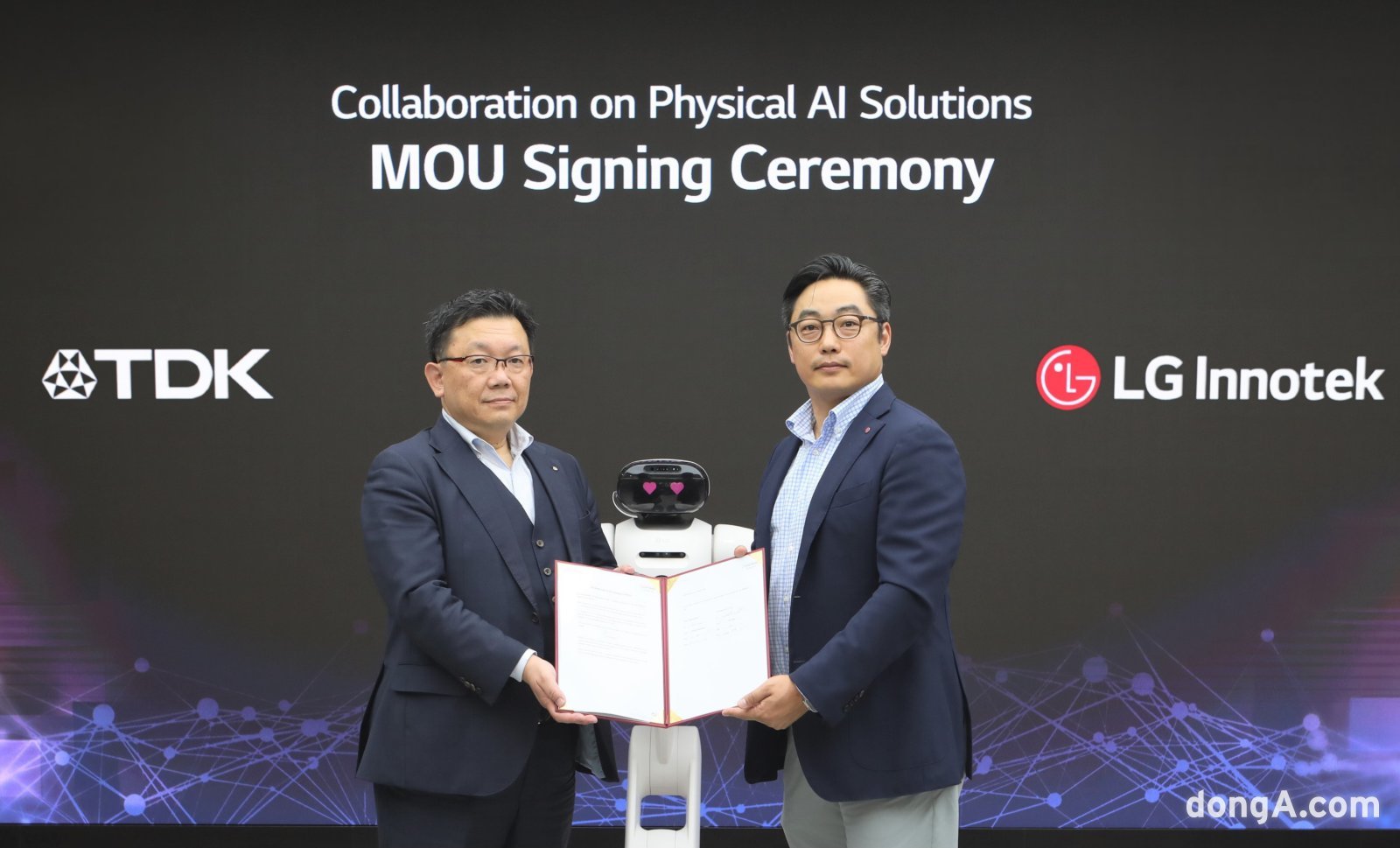
LG Innotek partners with Japan's TDK to expand into 'Physical AI' with tactile sensors
Translated from Korean, summarized and contextualized by DistantNews.
At a glance
News
Sources not specified
New plan
- LG Innotek and Japan's TDK have signed a partnership to develop "Physical AI" solutions, expanding beyond visual sensors to include tactile components.
- The collaboration aims to combine LG Innotek's optical technology with TDK's sensor expertise to create advanced sensor solutions for robots.
- The first joint product, an integrated vision sensor module with inertial and position sensors, is planned for commercialization in 2027, with tactile sensing modules to follow.
LG Innotek is significantly broadening its business scope beyond visual sensors, venturing into the realm of tactile components for robots through a strategic partnership with Japan's TDK. The two companies have established a collaboration focused on developing "Physical AI" solutions, aiming to integrate advanced sensing technologies for robotic applications.
This alliance will leverage LG Innotek's precision optical design capabilities and TDK's extensive sensor portfolio. Together, they plan to co-develop sophisticated sensor solutions, including next-generation vision sensing modules and tactile sensing modules, which are crucial for robot operation. TDK, a global electronic components manufacturer headquartered in Tokyo, has over two decades of experience in the sensor business, possessing a diverse range of core technologies essential for Physical AI, such as inertial measurement units (IMUs), position sensors, and pressure sensors.
The integration of various sensing devices into multi-sensing technology is emerging as a key topic in the robot industry. Leveraging our alliance with TDK, we will lead the robot core component ecosystem and solidify our dominance in the Physical AI market through collaboration with various global companies.
The initial phase of their collaboration involves integrating TDK's inertial and position sensors, along with acoustic microphones, into LG Innotek's vision sensor systems. This integration aims to go beyond simple visual data collection by processing positional changes, vibrations, and acoustic data to enhance robots' spatial awareness. For instance, incorporating TDK's inertial sensors will enable real-time correction of camera shake during robot locomotion or assistive device control, leading to more accurate visual data. This also offers robot manufacturers the advantage of receiving a unified module, simplifying assembly and improving production efficiency.
LG Innotek anticipates that the integrated modules resulting from this partnership will have broad applications. The company plans to commercialize an integrated vision module featuring inertial sensors by 2027. Concurrently, the partners will develop tactile sensing modules, designed to function as a "skin" for robots. These modules, targeted for completion by 2027, will be applied to robot fingers, joints, and bodies to precisely detect physical contact and the intensity of applied pressure. The development of these highly complex, thin, and flexible tactile components is considered vital for the next generation of intelligent robots.
We are pleased to partner with LG Innotek, which possesses top-tier sensing technology. By combining TDK's core technologies with LG Innotek's manufacturing capabilities, we will introduce innovative products that will change the market paradigm.
DistantNews Editorial
Originally published by Dong-A Ilbo in Korean. Translated, summarized, and contextualized by our editorial team with added local perspective. Read our editorial standards.
More Stories



From Our Blog

What Gets Lost (and Found) When News Is Translated

The Critical Role of Diaspora Media in Global News

What Travellers Should Know About Countries with Restricted Press

A Digital Nomad's Guide to Following Local News

How the Same Story Looks Different in Different Countries
