

LG, Nvidia partner on humanoid robots, AI factory development
Translated from Korean, summarized and contextualized by DistantNews.
At a glance
News
Named sources
New plan
- LG and Nvidia are partnering to co-develop humanoid robots and an AI factory, with a new robot model set for release in the first quarter of next year.
- The collaboration will also see the construction of an 80MW AI factory in Cheonan, South Korea, by 2028, integrating LG's affiliate technologies with Nvidia's AI platforms.
- This strategic alliance aims to expand joint projects in physical AI and mobility, leveraging LG's manufacturing expertise and Nvidia's AI technology.
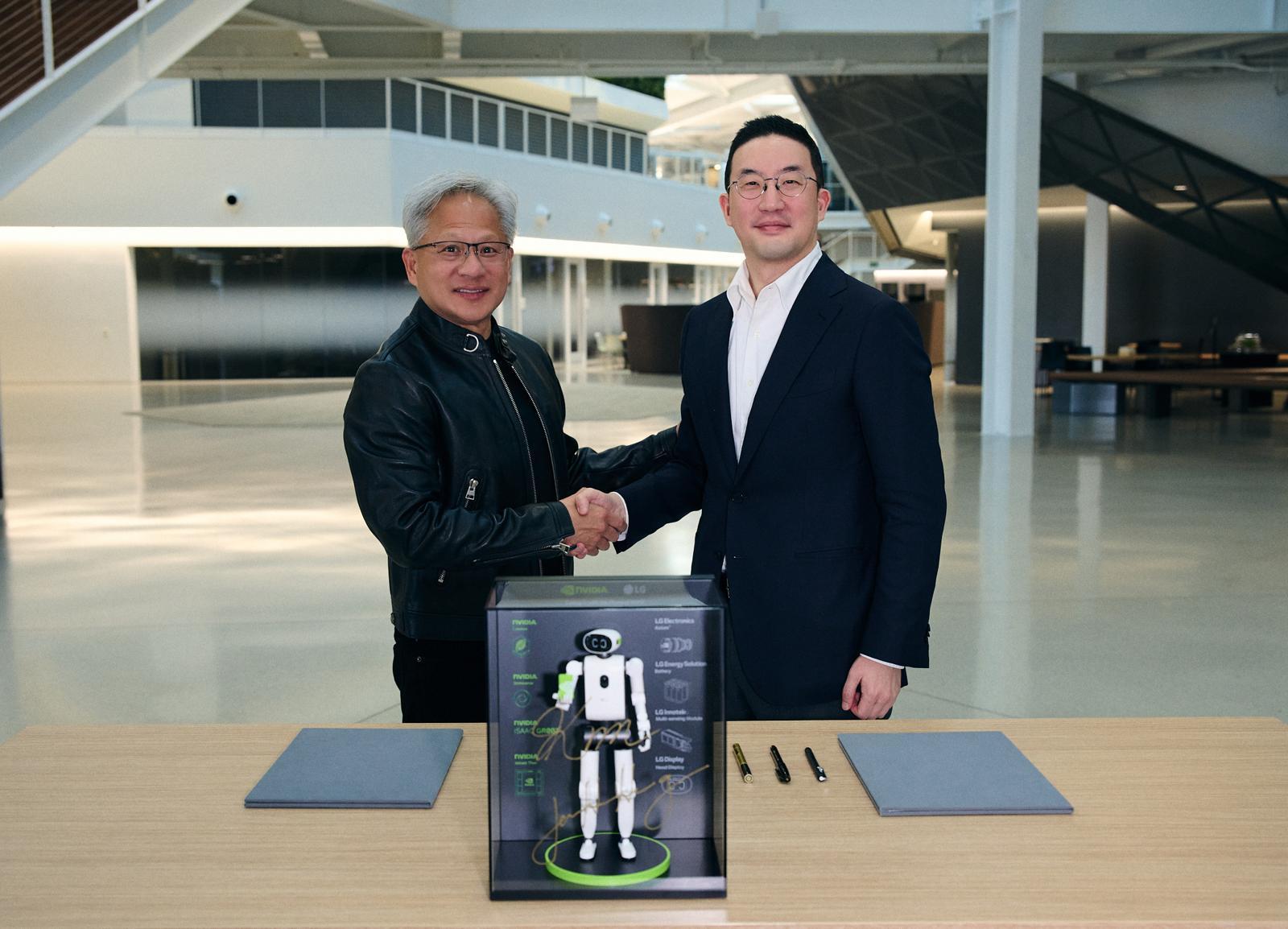
LG and Nvidia are forging a significant partnership to accelerate advancements in robotics and artificial intelligence. The collaboration, formalized through a Memorandum of Understanding signed at Nvidia's headquarters in Santa Clara, California, will focus on three key areas: humanoid robots, AI factories, and mobility.
The collaboration between our two companies is accelerating, clarifying the tasks we will undertake together in the fields of AI factories, physical AI, and mobility.
Leading the charge is the co-development of a next-generation bipedal humanoid robot, slated for a public debut in the first quarter of next year. This robot will integrate Nvidia's advanced platforms, including the Jetson Thor computing system and Isaac GR00T foundation model, with LG's proprietary technologies such as actuators from LG Electronics, sensors from LG Innotek, and batteries from LG Energy Solution. This synergy aims to create a robot with enhanced intelligence and physical capabilities.
Beyond robotics, the partnership extends to the creation of a large-scale AI factory. LG plans to establish a reference site by the first half of 2027, utilizing Nvidia's next-generation AI platform, 'Vera Rubin.' This will be followed by an 80MW AI factory in Cheonan, South Korea, by the first half of 2028. This facility will employ a prefabricated construction method to shorten building times by over 20%, integrating cooling, power, and IT solutions from various LG affiliates and LS.
The most important opportunity that physical AI offers is in enabling all machines to understand and reason about the real world and act safely with people.
The collaboration also targets the mobility sector, with plans to jointly develop high-performance computing platforms for AI-defined vehicles (AIDVs) based on Nvidia's Drive Hyperion platform. LG aims to expand its automotive electronics business beyond infotainment to autonomous driving, offering integrated solutions to global automakers. A joint task force will oversee research, development, and commercialization efforts, underscoring a shared commitment to pushing the boundaries of AI and robotics.
By combining LG's product engineering and manufacturing capabilities with Nvidia's technology, we are accelerating the new era of robots, AI factories, and autonomous vehicles.
DistantNews Editorial
Originally published by Dong-A Ilbo in Korean. Translated, summarized, and contextualized by our editorial team with added local perspective. Read our editorial standards.
More Stories

From Our Blog

What Gets Lost (and Found) When News Is Translated

The Critical Role of Diaspora Media in Global News

What Travellers Should Know About Countries with Restricted Press

A Digital Nomad's Guide to Following Local News

How the Same Story Looks Different in Different Countries
