

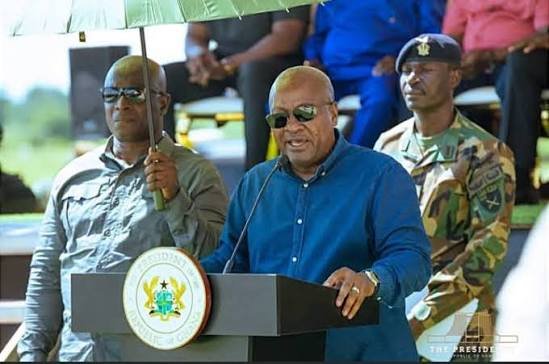

Lord Ibrahim Sani calls for national reset on youth unemployment
Summarized and contextualized by DistantNews.
At a glance
News
Official statement
Context piece
- Lord Ibrahim Sani, an independent presidential aspirant, urges Ghana to fundamentally rethink its approach to youth unemployment.
- He argues that a significant portion of Ghana's youth lacking employment hinders long-term economic prosperity.
- Sani advocates for creating an economic environment that fosters sustainable job creation by the private sector, rather than relying solely on government programs.
Ghana must undertake a fundamental reset in its strategy to tackle youth unemployment, according to independent presidential aspirant Lord Ibrahim Sani. He asserts that the nation's long-term economic prosperity is jeopardized by the large number of young people without meaningful work opportunities. Sani frames the issue not just as an employment problem but as a critical concern for national development that demands immediate, coordinated action.
Recent data from the Ghana Statistical Service indicates a youth unemployment rate of 34.4% in the third quarter of 2025, underscoring the urgency of Sani's call. He believes Ghana's response should shift focus from temporary government initiatives to cultivating an economic climate where businesses, entrepreneurs, and industries can generate lasting employment. Sani questions the efficacy of asking how many temporary jobs the government can create, instead proposing to ask what kind of economy can continuously generate millions of productive jobs.
We should stop asking how many temporary jobs government can create and start asking what kind of economy can continuously create millions of productive jobs.
Sani emphasizes that the government alone cannot absorb Ghana's growing youth population. He calls for positioning the private sector as the primary engine for job creation. This, he argues, necessitates stable economic policies, reliable infrastructure, accessible and affordable capital, efficient public institutions, and a business environment conducive to the growth of Ghanaian companies.
Access without economic opportunity creates frustration.
Furthermore, Sani stresses the need for stronger alignment between the education system and the demands of the productive economy. He champions increased investment in technical and vocational education, apprenticeships, and industry-specific training to equip young people with employable skills. "Access without economic opportunity creates frustration," he stated, highlighting that education must be relevant to the labor market's realities. Entrepreneurship, he added, should be recognized as a viable economic path, with young innovators receiving support in mentorship, finance, technology, and market access.
Identifying agriculture as a key area for youth employment, Sani advocates for viewing it as a modern industry rather than solely subsistence farming. He envisions agriculture encompassing technology, mechanization, food processing, logistics, storage, marketing, and exports. This approach, he believes, can create jobs across the agricultural value chain while boosting Ghana's domestic production and export capabilities. He also urged Ghana to leverage its youth demographic for the expanding digital economy.
A young Ghanaian can be a farmer, agronomist, food processor, logistics operator, drone technician, software developer, equipment technician, exporter or agribusiness manager.
DistantNews Editorial
Originally published by Daily Graphic. Summarized and contextualized by our editorial team with added local perspective. Read our editorial standards.
More Stories


From Our Blog

What Gets Lost (and Found) When News Is Translated

The Critical Role of Diaspora Media in Global News

What Travellers Should Know About Countries with Restricted Press

A Digital Nomad's Guide to Following Local News

How the Same Story Looks Different in Different Countries
