


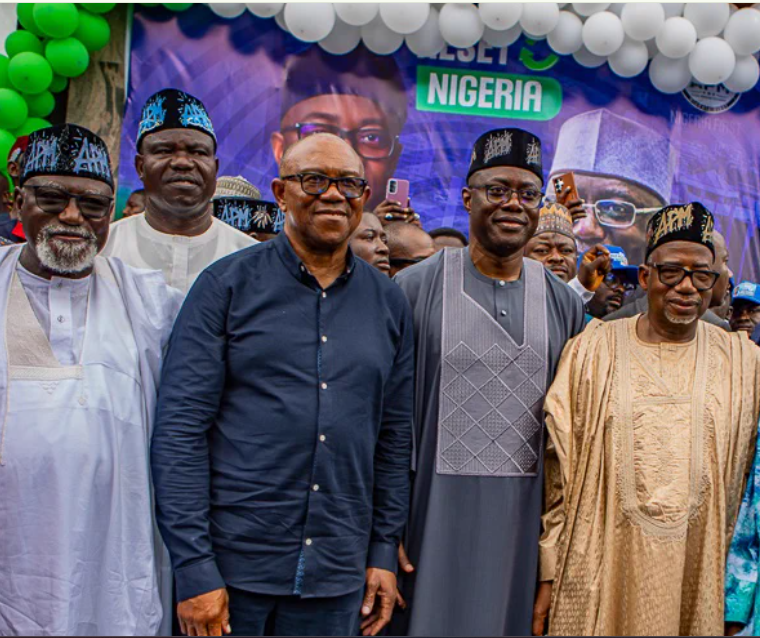

Makinde and Obi rally opposition behind ‘Reset Nigeria’ ahead of 2027 election
Translated from English and summarized by DistantNews. Read the original for the full story.
At a glance
News
Named sources
Ongoing story
- Opposition figures including Seyi Makinde, Peter Obi and Bala Mohammed launched the “Reset Nigeria” agenda at the opening of the Allied Peoples Movement’s campaign office in Abuja.
- Makinde rejected a return to fuel subsidies but called for domestic crude pricing for Nigerian refineries to make petrol more affordable.
- He demanded transparency across the petroleum value chain, while Atiku Abubakar has promised to restore the subsidy if elected president.
Nigeria’s opposition is gathering behind a “Reset Nigeria” agenda ahead of the 2027 election, with Seyi Makinde rejecting a return to fuel subsidies while proposing a different way to lower petrol prices.
Makinde, the presidential candidate of the Allied Peoples Movement, unveiled the platform in Abuja on Monday alongside Peter Obi, the Nigeria Democratic Congress candidate, Bala Mohammed, the APM national leader and Bauchi State governor, and other opposition figures. They expressed confidence that Nigerians’ votes would count in the next general election.
Makinde said Nigerian refineries should receive domestic crude at a price that reflects the fact that the oil is produced in Nigeria. He rejected the proposal by former Vice President Atiku Abubakar, the African Democratic Congress presidential candidate, to restore the subsidy removed by President Bola Tinubu in 2023. Atiku had pledged to scrap the subsidy during the 2023 campaign but now says restoring it would ease the pressure created by its removal.
I have spoken about the petrol pricing framework. Some people have asked whether I am suggesting that we bring back the old fuel subsidy. That is not my position.
“I have spoken about the petrol pricing framework. Some people have asked whether I am suggesting that we bring back the old fuel subsidy. That is not my position,” Makinde said. He compared the issue to a community growing its own food and then being charged as if the food had travelled halfway around the world. “So, why should crude oil supplied to Nigerian refineries be priced as though Nigeria does not produce crude oil?”
Makinde said Nigerians should be able to see how the final petrol price is calculated, who benefits from payments and where inefficiencies increase costs. He called for complete transparency from production and domestic crude allocation through refining, transport, distribution, taxes and retail margins. The article ends during his statement that this benefit should be built into the system.
So, why should crude oil supplied to Nigerian refineries be priced as though Nigeria does not produce crude oil?
About this summary
Originally published by The Punch in English. Translated, summarized, and contextualized automatically by DistantNews, with a note on how the source frames the story. Not individually reviewed before publishing. How this works.
More Stories


From Our Blog

The Same Story, Different Countries: How Coverage Changes at the Border

News in Translation: What Gets Lost, and How We Keep the Framing

Diaspora Media: How Communities Follow News From Home

Traveling Where the Press Is Not Free: How to Read the News There

The Digital Nomad's Guide to Local News
