

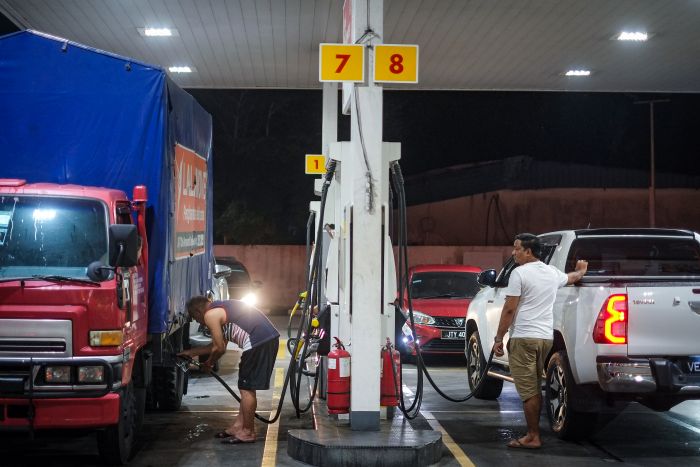

Malaysia's Energy Market Seen Stabilizing Gradually in Q3 2026
Translated from Malay, summarized and contextualized by DistantNews.
At a glance
News
Named sources
Context piece
- Malaysia's energy market is expected to stabilize gradually in the third quarter of 2026, depending on geopolitical stability and trade routes.
- The Minister of Economy stated that price and supply uncertainties will continue to affect the market for the next one to two years.
- The government is implementing measures, including 27 out of 120 economic council decisions, to mitigate the impact of global crises on citizens and businesses.
Malaysia's energy market is projected to achieve gradual stabilization in the third quarter of 2026, contingent upon geopolitical stability and the smooth resumption of international trade routes, according to Minister of Economy Akmal Nasrullah Mohd. Nasir.
Although crude oil prices have currently moderated compared to the previous highest levels, the impact on logistics costs, refined fuel supplies, agricultural inputs, and commodity prices will take time to stabilize again.
Despite a moderation in crude oil prices from previous highs, the lingering effects on logistics costs, refined fuel supplies, agricultural inputs, and general commodity prices are expected to persist for the next one to two years. "Although crude oil prices have currently moderated compared to the previous highest levels, the impact on logistics costs, refined fuel supplies, agricultural inputs, and commodity prices will take time to stabilize again," Nasir explained.
He further noted that while the energy market is anticipated to stabilize in phases starting in Q3 2026, this remains subject to geopolitical conditions and trade flow normalization. "Uncertainty in energy prices and supply is expected to continue influencing the market for another one to two years," he added.
Uncertainty in energy prices and supply is expected to continue influencing the market for another one to two years.
Nasir assured that the government would not wait for a full recovery, committing to continuous monitoring and intervention throughout the recovery period. This proactive approach aims to alleviate pressure on the public, Micro, Small, and Medium Enterprises (PMKS), and industries. The government has already implemented 27 of 120 decisions from the National Economic Action Council (MTEN) to address the initial impacts of global crises, with the remaining 93 decisions currently in the implementation phase.
I want, from the start of construction until the waste-to-energy facility operates, the people of Bekasi, especially the residents of Bantargebang, to be prioritized in employment.
DistantNews Editorial
Originally published by Utusan Malaysia in Malay. Translated, summarized, and contextualized by our editorial team with added local perspective. Read our editorial standards.
More Stories


From Our Blog

What Gets Lost (and Found) When News Is Translated

The Critical Role of Diaspora Media in Global News

What Travellers Should Know About Countries with Restricted Press

A Digital Nomad's Guide to Following Local News

How the Same Story Looks Different in Different Countries
