


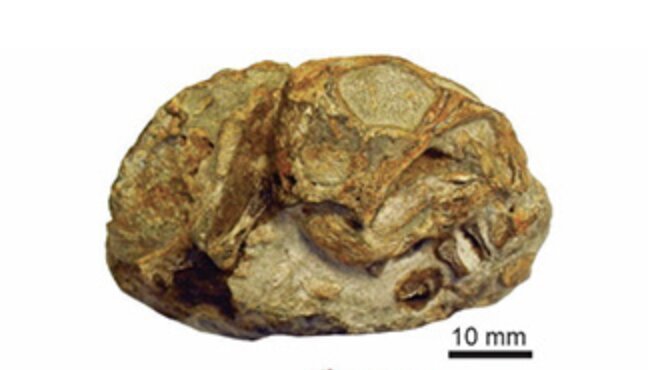
Mammal Ancestors Laid Eggs 250 Million Years Ago, Fossil Discovery Reveals
Translated from Korean, summarized and contextualized by DistantNews.
TLDR
- Scientists have confirmed direct evidence that the distant ancestors of mammals reproduced by laying eggs approximately 250 million years ago.
- Analysis of a Lystrosaurus embryo fossil found in South Africa revealed characteristics similar to modern egg-laying animals.
- This discovery provides crucial insights into the evolutionary transition from egg-laying to live birth in mammals.
A groundbreaking discovery from South Africa's Karoo Basin is rewriting our understanding of mammalian evolution. Researchers at the University of the Witwatersrand have unearthed fossilized evidence of Lystrosaurus embryos, a creature from the Permian period, suggesting that our distant mammalian ancestors reproduced by laying eggs.
Published in the journal 'PLOS One', the study utilized advanced synchrotron radiation equipment to meticulously analyze the fossilized embryos. The findings indicate that the jawbones of these ancient creatures were not fully fused, a trait characteristic of modern egg-laying animals like birds and turtles. This directly challenges the long-held assumption that early mammals exclusively gave birth to live young.
The Lystrosaurus, known to have thrived around 250 million years ago, was a herbivorous animal belonging to the lineage that eventually led to modern mammals. Its ability to lay relatively large eggs, potentially with leathery shells to conserve moisture in a harsh environment, likely contributed to its survival through the mass extinction event at the end of the Permian period.
This research is particularly significant for us in South Africa, as it sheds light on a critical juncture in evolutionary history that occurred right here on our continent. While Western media might focus on the 'shocking' revelation about mammals laying eggs, our local perspective emphasizes the resilience and adaptability of life in ancient Gondwana, and how these early creatures laid the groundwork for the diverse mammalian life we see today. It's a testament to the rich paleontological heritage found within the Karoo.
DistantNews Editorial
Originally published by Dong-A Ilbo in Korean. Translated, summarized, and contextualized by our editorial team with added local perspective. Read our editorial standards.
More Stories


From Our Blog

What Gets Lost (and Found) When News Is Translated

The Critical Role of Diaspora Media in Global News

What Travellers Should Know About Countries with Restricted Press

A Digital Nomad's Guide to Following Local News

How the Same Story Looks Different in Different Countries
