


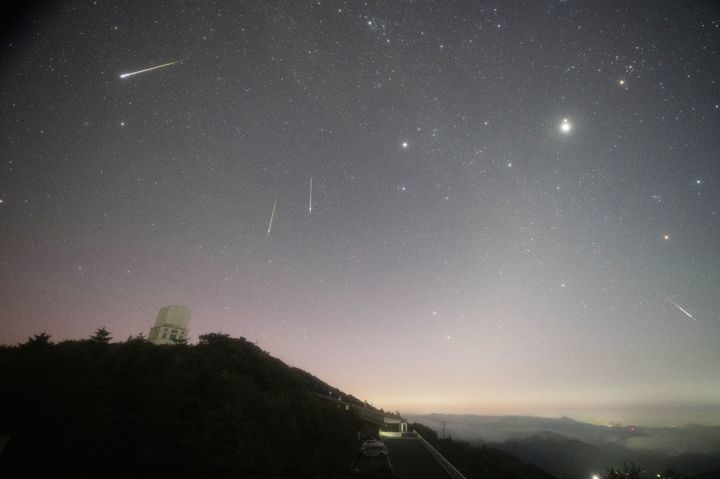
Meteor shower to light up the sky tonight with up to 100 shooting stars per hour
Translated from Korean, summarized and contextualized by DistantNews.
At a glance
News
Sources not specified
Context piece
- The Perseid meteor shower is expected to peak on August 12-13, offering optimal viewing conditions with minimal moonlight interference.
- Up to 100 meteors per hour may be visible under ideal circumstances from dark, open locations.
- August also features other astronomical events, including a planetary parade and a total solar eclipse visible in some regions.
Stargazers in South Korea are in for a treat as the annual Perseid meteor shower reaches its peak on the night of August 12 and into the early morning of August 13. This year's viewing conditions are particularly favorable, coinciding with a new moon, which means minimal light pollution from the moon itself.
Astronomers predict that up to 100 meteors per hour could be visible during the shower's peak. The Perseids occur annually when the Earth passes through the debris trail left by the comet Swift-Tuttle. For the best experience, observers are advised to find a dark location away from city lights with a clear view of the sky.
While the calculated peak time is midday on August 13 in Korea, the preceding night and the early morning of the 13th and 14th offer excellent opportunities for observation. The shower is best viewed with the naked eye, requiring no special equipment.
Beyond the meteor shower, August is proving to be a busy month for celestial events. Earlier on August 12, a planetary parade featuring Mercury, Jupiter, Mars, Uranus, Saturn, and Neptune was visible. Additionally, a total solar eclipse will occur on August 13, though it will only be observable in specific regions like Greenland, Iceland, and parts of Spain, not in Korea.
DistantNews Editorial
Originally published by Dong-A Ilbo in Korean. Translated, summarized, and contextualized by our editorial team with added local perspective. Read our editorial standards.
More Stories



From Our Blog

What Gets Lost (and Found) When News Is Translated

The Critical Role of Diaspora Media in Global News

What Travellers Should Know About Countries with Restricted Press

A Digital Nomad's Guide to Following Local News

How the Same Story Looks Different in Different Countries
