


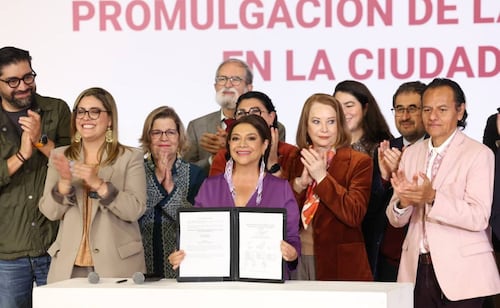
Mexico City enacts care law, aiming to end women's sole responsibility
Translated from Spanish, summarized and contextualized by DistantNews.
At a glance
News
Sources not specified
New plan
- Mexico City's government has enacted a new law on care work, aiming to destigmatize and redistribute responsibilities historically shouldered by women.
- The law recognizes care as a human right and mandates government investment in infrastructure and services to support it.
- This initiative seeks to address historical social debt owed to women and establish a feminist constitutional framework.
Mexico City's government has launched a pioneering Law on Care, a move aimed at fundamentally reshaping how society views and manages caregiving responsibilities. Mayor Clara Brugada championed the law, stating it opens a path to "destigmatize, de-commodify, and de-familiarize" care work, which has long been relegated to women.
"Caring is essential for society as a whole and is the responsibility of everyone, not just women, not just families, not just the market, and not just the government," Brugada declared. She highlighted Mexico City's recent constitutional amendment to eradicate the sexual division of labor, marking a step towards "new feminist constitutionalism."
The law acknowledges caregiving as a human right, encompassing the right to care, to be cared for, and to self-care. It also imposes a governmental obligation to build new care infrastructure and progressively expand public services, a commitment Brugada stressed is "non-negotiable and trans-presidential" until the Care System achieves full universality.
Brugada emphasized that the law is a crucial step in addressing the historical debt owed to women, many of whom have sacrificed education, careers, or dreams due to the unequal burden of care. The legislation aims to ensure that care work is recognized as a shared societal responsibility, moving away from the notion of it being solely a woman's or family's duty.
DistantNews Editorial
Originally published by El Universal in Spanish. Translated, summarized, and contextualized by our editorial team with added local perspective. Read our editorial standards.
More Stories



From Our Blog

What Press Freedom Means for the News You Read

What Gets Lost (and Found) When News Is Translated

The Critical Role of Diaspora Media in Global News

What Travellers Should Know About Countries with Restricted Press

A Digital Nomad's Guide to Following Local News
