


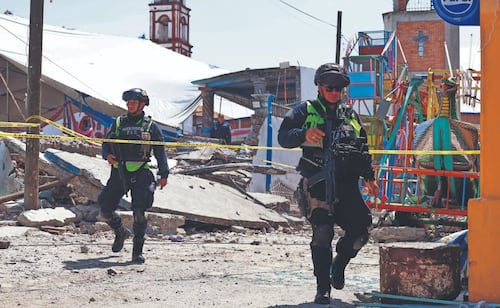

Mexico City to bring major earthquake drill to Xochimilco
Translated from Spanish and summarized by DistantNews. Read the original for the full story.
At a glance
News
Named sources
New plan
- Mexico City will stage two emergency scenarios during the Second National Drill on Sept. 19, including one in Xochimilco and another at Plaza de la República.
- Emergency services will demonstrate search, rescue, victim stabilization and extraction techniques under a simulated magnitude 7.7 earthquake scenario.
- Authorities said 11,000 buildings had registered by the previous week, while officials urged residents to take part.
Mexico City will take its major emergency drill to Xochimilco this year, staging a simulated disaster at the borough’s sports center alongside another scenario at Plaza de la República, in front of the Monument to the Revolution.
The exercises will form part of the Second National Drill on Sept. 19. City emergency services will use the sites to demonstrate search, rescue, victim location, stabilization and extraction techniques.
Myriam Urzúa, head of the Secretariat for Comprehensive Risk Management and Civil Protection, said authorities were making an extra effort to bring residents into the exercise because it will take place on a Saturday. Officials especially want people living in housing complexes to participate while families are likely to be at home.
We are making a greater effort to invite all residents, especially those who live in housing complexes, to participate actively in this drill, taking advantage of the fact that families will practically all be in their homes.
The drill will test the response capacity of emergency teams and continue evaluating Mexico City’s earthquake emergency plan. Authorities will also measure how quickly the seismic alert spreads and how long residents take to shelter or evacuate.
The exercise will simulate a magnitude 7.7 earthquake with an epicenter 15 kilometers south-southwest of Tehuacán, Puebla, at a depth of 67 kilometers. Registration remains open through the national drill website, and SGIRPC said 11,000 buildings had enrolled by the previous week.
Of course, it allows us to continue measuring the alert dissemination times, as well as the sheltering and evacuation times on that day.
About this summary
Originally published by El Universal in Spanish. Translated, summarized, and contextualized automatically by DistantNews, with a note on how the source frames the story. Not individually reviewed before publishing. How this works.
More Stories
From Our Blog

What Press Freedom Means for the News You Read

News in Translation: What Gets Lost, and How We Keep the Framing

Diaspora Media: How Communities Follow News From Home

Traveling Where the Press Is Not Free: How to Read the News There

The Digital Nomad's Guide to Local News
