


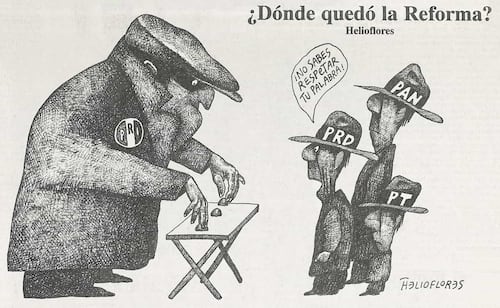
 Image: Hemeroteca EL UNIVERSAL.
Mexico's 1996 Electoral Reform: A 30-Year Look Back at Party Benefits Over Citizen Gains
Translated from Spanish and summarized by DistantNews. Read the original for the full story.
At a glance
Analysis
Sources not specified
Context piece
- Mexico's 1996 electoral reform, initiated by President Ernesto Zedillo, aimed to democratize the nation's voting system after decades of PRI rule.
- Despite intentions for broad political consensus, the reform process involved significant disagreements among major parties, including the PRI, PAN, PRD, and PT.
- Thirty years later, the reform is criticized for primarily serving the interests of political parties rather than enhancing citizen participation or trust in elections.
Thirty years ago, Mexican President Ernesto Zedillo Ponce de León called for a "democratic life worthy of our history." His administration embarked on an electoral reform aimed at restoring public confidence in the nation's voting processes, which had been marred by decades of Institutional Revolutionary Party (PRI) dominance, characterized by alleged election fraud, excessive spending, and the misuse of state institutions.
Mexicans want a democratic life worthy of our history [...] however, democratic advances are still insufficient.
The reform process, initiated with the National Political Agreement for Electoral Reform signed in January 1995, involved leaders from the PRI, National Action Party (PAN), Party of the Democratic Revolution (PRD), and Labor Party (PT). The goal was to create a unified, democratic electoral model. However, the path to reform was fraught with discord, with parties frequently withdrawing from discussions when disagreements arose.
Despite the stated intentions of fostering democracy, the 1996 electoral reform is now viewed by many as having primarily benefited the political parties themselves, rather than the citizens it was meant to serve. The changes, while legitimizing certain aspects of Mexican elections, are seen as having perpetuated existing political strategies that allowed some parties to maintain power.
There is a long way from saying to doing.
The legacy of this reform is a complex one, highlighting the persistent tension between institutional political maneuvering and the genuine empowerment of the electorate. As Mexico reflects on this pivotal moment, questions remain about whether the reforms truly delivered on their promise of a more equitable and representative democratic system for all its citizens.
Our party is not in a hurry to carry out an electoral reform.
About this summary
Originally published by El Universal in Spanish. Translated, summarized, and contextualized automatically by DistantNews, with a note on how the source frames the story. Not individually reviewed before publishing. How this works.
More Stories

From Our Blog

What Press Freedom Means for the News You Read

What Gets Lost (and Found) When News Is Translated

The Critical Role of Diaspora Media in Global News

What Travellers Should Know About Countries with Restricted Press

A Digital Nomad's Guide to Following Local News
