


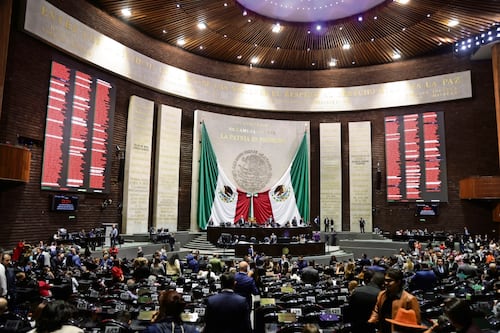
Mexico's Chamber of Deputies Restructures Finances Amid Excessive Spending
Translated from Spanish, summarized and contextualized by DistantNews.
At a glance
News
Named sources
New plan
- Mexico's Chamber of Deputies is implementing financial restructuring due to excessive spending, primarily driven by disproportionate increases in funds for the union and pensioners.
- The chamber's budget grew 61.5% between 2012 and 2025, with union-related expenses rising 157% and now consuming nearly 20% of the total budget.
- To curb the crisis, extraordinary financial support for retirees has been suspended, and a significant pay gap exists between unionized and non-unionized staff.
Mexico's Chamber of Deputies is undergoing a significant financial overhaul as Secretary General Mauricio Farah Gebara acknowledges "excessive spending." The core of the issue lies in the "disproportionate increase in resources allocated to the union and pensioners," which has outpaced the general institutional budget.
the spending of San Lázaro grew disproportionately.
From 2012 to 2025, the Chamber's overall budget is set to increase by 61.5%, reaching 9.6 billion pesos. However, funds designated for the union have surged by 157%, from 674 million to 1.73 billion pesos. This means nearly 20 pesos of every 100 approved for the Chamber are now linked to union expenses. The impact is particularly stark in personnel services, where three out of every ten pesos are tied to union commitments.
the disproportionate increase in resources destined for the union and pensioners, which grew 2.5 times greater than the general institutional budget between 2012 and 2025.
A significant pay disparity also exists. Unionized employees, numbering 1,386, receive an average gross monthly salary of 67,998 pesos. In contrast, the 4,622 non-unionized employees earn an average of 35,000 pesos, a gap of 94%. The union also benefits from 60 ongoing benefits costing 760 million pesos annually, plus an institutional contribution of 70,000 pesos per month for its operations.
Due to the unsustainability of this spending and that approximately 50 retirees were incorporated into this benefit each year, starting in April of this year these amounts are not paid to them.
To address the "unsustainable" expenditure, the General Secretariat has suspended extraordinary financial support for retirees. Previously, retirees received an additional 14,000 pesos monthly and 52,736 pesos in December, a benefit that ballooned from 14.3 million pesos in 2012 to 102 million pesos in the 2025 budget, an increase of over 600%. While this scheme is being permanently canceled, a one-time support payment of 52,000 pesos has been provided.
a unique support of 52 thousand pesos.
DistantNews Editorial
Originally published by El Universal in Spanish. Translated, summarized, and contextualized by our editorial team with added local perspective. Read our editorial standards.
More Stories


From Our Blog

What Press Freedom Means for the News You Read

What Gets Lost (and Found) When News Is Translated

The Critical Role of Diaspora Media in Global News

What Travellers Should Know About Countries with Restricted Press

A Digital Nomad's Guide to Following Local News
