



MSPO shows how the defence industry is changing
Translated from Polish and summarized by DistantNews. Read the original for the full story.
At a glance
In-depth
Sources not specified
Context piece
- Poland's MSPO defence exhibition has expanded from about 600 companies several years ago to more than 1,200 exhibitors this year.
- The exhibition reflects rising NATO defence spending, military modernisation and investment in production capacity, with Poland positioned as a major market on the alliance's eastern flank.
- Alongside heavy military equipment, exhibitors are highlighting drones, counter-drone systems, artificial intelligence, cybersecurity, space technology and other dual-use solutions.
The scale of Poland’s MSPO defence exhibition has surged. About 600 companies took part several years ago, compared with 811 last year and more than 1,200 exhibitors this year. Nearly 300 additional companies are represented through other firms.
The exhibition now covers more than 49,000 square metres, up from just under 38,000 square metres a year earlier. Displays fill 11 halls, including two temporary structures built specifically for the event, as well as outdoor areas. MSPO is also debuting a new 18,500-square-metre hall at Targi Kielce, described as the largest exhibition facility built in Poland in recent years.
Canada, the leading country at MSPO 2026, has brought nearly 200 companies. Other large foreign contingents include Germany with 105 companies, the United States with 90, the Netherlands with 53, Australia with 52, Britain with 46, France with 36 and Ukraine with 31. Italy, Sweden, the Czech Republic, Lithuania, Turkey and South Korea are also represented.
The exhibition’s growth follows a major shift in Europe’s defence market, the article says. NATO countries are increasing security spending, modernising their armed forces and rebuilding production capacity. Poland’s position on the alliance’s eastern flank has made it one of the world defence industry’s most important markets, while the European Union’s SAFE instrument offers an additional investment impulse.
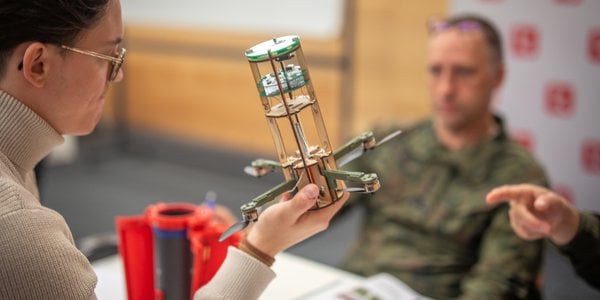
The industry itself is broadening beyond tanks, artillery, missiles and military vehicles. Electronics, automation, artificial intelligence, cybersecurity, space technology and dual-use systems are gaining prominence. At Kielce, exhibitors are presenting reconnaissance and strike drones, loitering munitions, unmanned ground vehicles, maritime systems and counter-drone technologies based on interception, electronic warfare and lasers. Featured systems include the SYLAND laser counter-drone system, WB Group’s GLADIUS II and Airbility’s KAMD system.
About this summary
Originally published by Rzeczpospolita in Polish. Translated, summarized, and contextualized automatically by DistantNews, with a note on how the source frames the story. Not individually reviewed before publishing. How this works.
More Stories



From Our Blog

News in Translation: What Gets Lost, and How We Keep the Framing

Diaspora Media: How Communities Follow News From Home

Traveling Where the Press Is Not Free: How to Read the News There

The Digital Nomad's Guide to Local News

The Same Story, Different Countries: How Coverage Changes at the Border
