


Museum preserves rare specimens, including extinct parrot
Translated from German, summarized and contextualized by DistantNews.
At a glance
In-depth
From a news agency
Context piece
- The Senckenberg Research Institute and Natural History Museum in Frankfurt houses over 40 million objects, including rare specimens of extinct species.
- Among its vast collection are over 100,000 bird preparations, including a Cuban Amazon parrot, extinct since around 1870, with fewer than 20 specimens worldwide.
- The museum's collection, established in 1821, requires careful climate control and pest prevention, such as moth powder, to preserve its fragile specimens for research and exhibition.
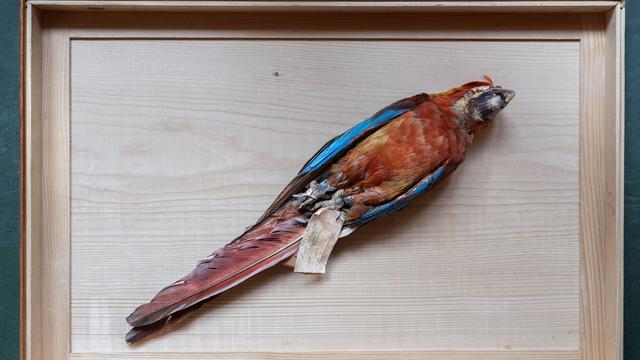
A pungent smell of moth powder fills the air within the Senckenberg Research Institute and Natural History Museum in Frankfurt, where over 100,000 preserved bird specimens are stored in towering wooden cabinets. Among these is a rare Cuban Amazon parrot, a species declared extinct around 1870, with fewer than 20 historical specimens existing globally. Gerald Mayr, head of ornithology at the museum, carefully retrieves the colorful parrot from a drawer, highlighting its significance.
This is a Cuban Amazon parrot, a parrot from the island of the same name. This species became extinct around 1870.
The museum's collection is vast, encompassing over 40 million objects, with a significant portion housed in Frankfurt and other cities like Dresden and Görlitz. Established in 1821, the Frankfurt Senckenberg Naturmuseum displays approximately 11,000 exhibits, famously including dinosaur skeletons and a detailed anaconda-swallowing-capybara diorama. Special exhibitions often draw upon the hidden treasures within the collections, which primarily serve scientific research.
This is pretty rare by now, we only have two pieces of that, too. This is one of the smallest warm-blooded vertebrates at all.
These collections include fossils, plants, insects, bones, and preserved animals. For instance, over 1.2 million butterflies, including a large donation from the Philippines, are stored in one building. Steffen Pauls, head of the terrestrial zoology department, explained that the butterfly collection must be maintained at around 18 degrees Celsius with 50 percent humidity to prevent the development of museum beetles.
They are like mummies, they would last forever if no insects got to them - or moisture.
Preserving the bird specimens, described as being "like mummies," requires protection from insects and moisture. Mayr explained that the moth powder smell is a consequence of these preservation efforts. Consistent temperatures, avoiding extremes of heat, cold, or humidity, are crucial to prevent mold. These preservation methods have proven effective for the past 200 years, safeguarding these invaluable scientific resources.
But that has worked quite well for 200 years now.
DistantNews Editorial
Originally published by Die Zeit in German. Translated, summarized, and contextualized by our editorial team with added local perspective. Read our editorial standards.
More Stories


From Our Blog

What Gets Lost (and Found) When News Is Translated

How the Same Story Looks Different in Different Countries

The Critical Role of Diaspora Media in Global News

What Travellers Should Know About Countries with Restricted Press

A Digital Nomad's Guide to Following Local News
