


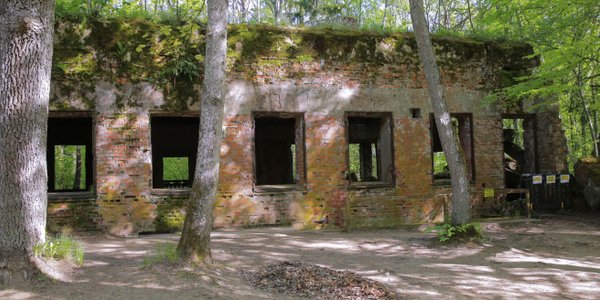
Mystery of skeletons in Hermann Göring's house in Wolf's Lair: Research begins
Translated from Polish, summarized and contextualized by DistantNews.
At a glance
News
Named sources
Under investigation
- Archaeologists have begun a three-week investigation at Hermann Göring's former house in the Wolf's Lair complex.
- The team hopes to solve the mystery of six human skeletons, including children's, found buried there in 2024.
- Previous investigations by prosecutors failed to identify the victims or the circumstances of their deaths.
Archaeologists have commenced a three-week excavation at the former home of Nazi official Hermann Göring within the Wolf's Lair complex, aiming to unravel the mystery surrounding human remains discovered on the site.
I hope that the archaeologists' work and their findings will bring us closer to solving the mystery of which people were buried in the place where Hermann Göring is located.
The team, comprising experts from the Polish Academy of Sciences and the Latebra Foundation, will focus on the area where six shallowly buried skeletons, including those of children, were found in 2024. These remains, discovered about 20 cm below the surface in a non-basement part of the building, were missing hands and feet.
Despite a previous investigation by prosecutors, the identities of the victims, the time and circumstances of their deaths, and the reasons for their burial at this specific location remain unknown. The investigation was ultimately closed without resolution.
Our work aims, on the one hand, to examine whether there are missing fragments of already found skeletons or other skeletons, other burials in this building.
Lead archaeologist Jakub M. Niebylski stated that the current work aims to determine if any missing skeletal fragments exist at the site or if other burials are present. Researchers will also examine the positioning of the burials relative to the building's walls and cardinal directions, and whether the interments predate the structure itself.
We also want to determine the positioning of the burials relative to the building's walls and cardinal directions. We also want to determine whether the burials at this location are older than the building or not.
Concurrently, the archaeologists will investigate the building's construction, which featured wooden walls covered by a brick and reinforced concrete shell. The Latebra Foundation is also employing other methods to solve the puzzle of the burials, awaiting further research results. While archaeologists are currently working in a different section of the building, they will gradually move towards the area where the skeletons were found, meticulously sifting through soil and examining all discovered artifacts, which so far include small everyday items like nails.
We are still working on it, we are still waiting for certain research results.
DistantNews Editorial
Originally published by Rzeczpospolita in Polish. Translated, summarized, and contextualized by our editorial team with added local perspective. Read our editorial standards.
More Stories



From Our Blog

What Gets Lost (and Found) When News Is Translated

The Critical Role of Diaspora Media in Global News

What Travellers Should Know About Countries with Restricted Press

A Digital Nomad's Guide to Following Local News

How the Same Story Looks Different in Different Countries
