


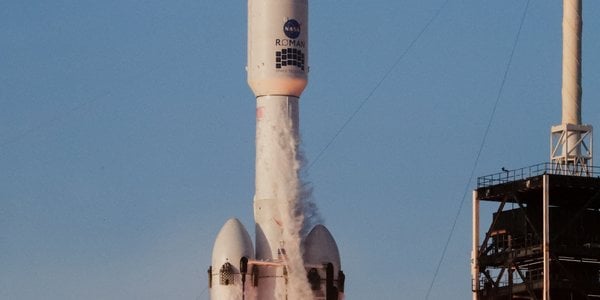
NASA launches telescope to search for up to 100,000 new exoplanets
Translated from Polish and summarized by DistantNews. Read the original for the full story.
At a glance
News
Official statement
Ongoing story
- NASA launched the Nancy Grace Roman Space Telescope from Florida aboard a SpaceX Falcon Heavy rocket.
- The telescope will travel about 1.6 million kilometers from Earth, where it will conduct wide-field infrared observations.
- NASA expects Roman to find tens of thousands, and possibly up to 100,000, exoplanets while studying dark energy, dark matter, galaxies and black holes.
The Nancy Grace Roman Space Telescope has begun its journey into space with an ambitious search ahead: NASA says it could identify as many as 100,000 exoplanets.
The observatory launched on Sunday morning local time from Kennedy Space Center in Florida aboard a SpaceX Falcon Heavy. About 30 minutes after liftoff, Roman separated from the rocket and began traveling toward its observation location, roughly 1.6 million kilometers from Earth.
Roman will change the way we look at the universe.
NASA official Nicky Fox said the telescope could change how scientists view the universe, with discoveries ranging from tens of thousands to around 100,000 new exoplanets. Project manager Jackie Townsend called the launch successful, saying the spacecraft reached the position intended after liftoff.
What a wonderful dawn launch!
Roman will operate about four times farther from Earth than the Moon. Astronomer Jennifer Millard told the BBC that this distance will help limit infrared interference from Earth and the Moon, which is important for the telescope’s infrared instruments. The James Webb Space Telescope works at a similar distance, but Roman will have a much wider field of view.
NASA expects the primary mission to last five years, although the observatory was designed to operate for up to a decade. Its surveys will support research into dark energy and dark matter, map billions of galaxies, analyze black holes and observe objects ranging from the Solar System to the farthest visible regions of the universe. The telescope honors Nancy Grace Roman, NASA’s first chief astronomer and the agency’s first woman to hold a senior leadership position. Her role in advancing the Hubble project earned her the nickname “mother of Hubble.”
The flight went perfectly. We found ourselves exactly where we wanted to be.
About this summary
Originally published by Rzeczpospolita in Polish. Translated, summarized, and contextualized automatically by DistantNews, with a note on how the source frames the story. Not individually reviewed before publishing. How this works.
More Stories



From Our Blog

What Gets Lost (and Found) When News Is Translated

The Critical Role of Diaspora Media in Global News

What Travellers Should Know About Countries with Restricted Press

A Digital Nomad's Guide to Following Local News

How the Same Story Looks Different in Different Countries
