


NATO's 'Kill Web' Ambition Meets Romanian Reality Amid Drone Threats
Translated from Romanian, summarized and contextualized by DistantNews.
At a glance
News
Sources not specified
Ongoing story
- NATO is developing a unified digital defense network, the 'kill web,' to instantly share threat data across its eastern flank.
- Incidents in Romania and the Baltics highlight the gap between this ambition and current ground-level capabilities.
- The war in Ukraine has underscored the need for interconnected sensors to counter diverse, low-flying threats like drones.
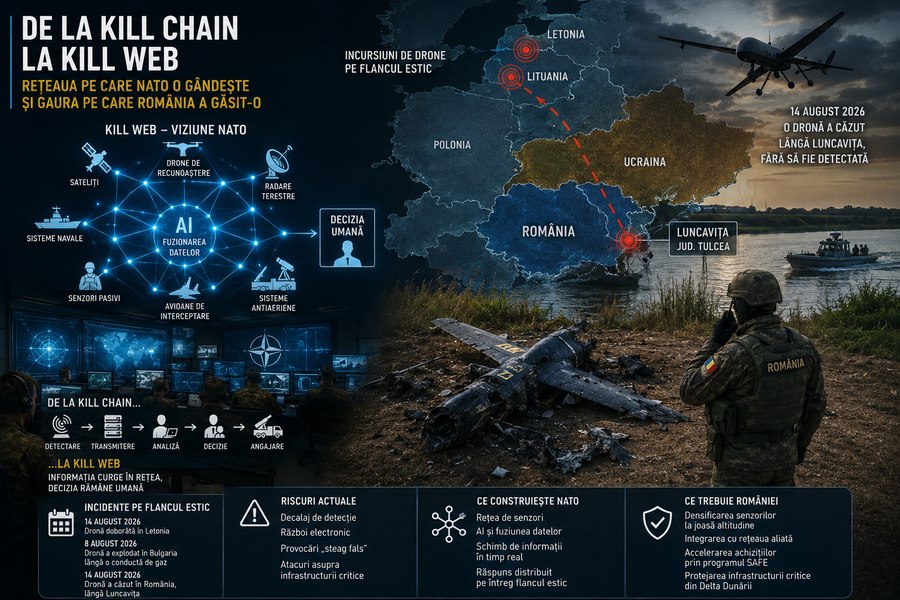
NATO is pursuing an ambitious digital defense strategy, dubbed the 'kill web,' aiming to create a seamless network connecting radars, drones, satellites, and artificial intelligence to instantly detect and respond to threats across its eastern flank.
The Alliance is trying to link radars, drones, satellites, and artificial intelligence into a single system, so that a threat observed at one point on the eastern flank becomes instantly visible to all.
The initiative, part of the Eastern Flank Deterrence Initiative (EFDI) and its digital backbone, seeks to move beyond isolated technological systems. The vision is that if a sensor detects a threat, that information will immediately reach decision-makers and neutralization capabilities. This concept was recently tested in Wiesbaden, Germany, where military personnel from NATO states like Finland, Lithuania, and Italy practiced communicating through a common architecture, with six allied states already connected to the network.
But incidents in Romania and the Baltic states show how far the distance is between this ambition and the reality on the ground, just a few dozen meters above the ground.
However, recent incidents in Romania and the Baltic states starkly illustrate the significant challenges in realizing this vision. In Romania, near the Ukrainian border, a drone reportedly reached the ground undetected by military systems, bypassing satellites and radars. It was eventually spotted by a civilian who alerted emergency services. This event, occurring simultaneously with NATO's presentation of its future defense network, underscores the vast difference between the alliance's aspirations and the reality on the ground.
It is no longer enough to have radar. Radars must talk to each other.
The war in Ukraine has fundamentally altered the landscape of air defense. The focus has shifted from detecting traditional aircraft or missiles to identifying hundreds or thousands of simultaneous threats, including small, low-flying drones of various types. This necessitates a doctrinal shift from a 'kill chain', a linear sequence of actions, to a 'kill web,' where interconnected sensors and systems provide real-time, comprehensive situational awareness. The Romanian incident highlights that simply having radar is insufficient; these systems must communicate with each other to effectively counter modern threats.
From 'kill chain' to 'kill web'.
DistantNews Editorial
Originally published by Adevărul in Romanian. Translated, summarized, and contextualized by our editorial team with added local perspective. Read our editorial standards.
More Stories


From Our Blog

What Gets Lost (and Found) When News Is Translated

The Critical Role of Diaspora Media in Global News

What Travellers Should Know About Countries with Restricted Press

A Digital Nomad's Guide to Following Local News

How the Same Story Looks Different in Different Countries
