


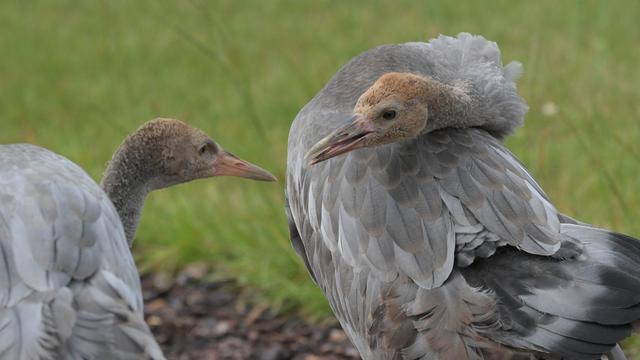
Nature conservation: Crane center unexpectedly receives young birds Ida and Michel
Translated from German, summarized and contextualized by DistantNews.
At a glance
News
Named sources
Context piece
- Two young cranes, Ida and Michel, have found a permanent home at Europe's largest crane center in Günz, Germany.
- The cranes cannot be released into the wild because they were imprinted on humans at a young age.
- Center staff are now caring for the birds, which requires dedicated, daily attention and a specially built aviary.
Ida and Michel, two young cranes who cannot be released into the wild, have found a new home at the Nabu-Erlebniszentrum Kranichwelten in Günz, Germany. The center, described as Europe's largest crane center, is now responsible for the birds' lifelong care.
The animals unfortunately cannot be released because they came into human hands so early. They became imprinted on humans and now only recognize people as their own species, not other cranes.
The cranes were found by walkers early in May and taken into human care. Günter Nowald, head of the center and managing director of the Society for Crane Protection Germany, recalled receiving a video of one of the young cranes walking around a kitchen. "The animals unfortunately cannot be released because they came into human hands so early," Nowald explained. "They became imprinted on humans and now only recognize people as their own species, not other cranes." Releasing them would be dangerous as they would seek human contact.
It's a new challenge that has now come our way, which we also have to manage with our personnel.
Ida and Michel are now exploring their fenced outdoor enclosure at the center, enjoying sprinklers and foraging for food. Nowald noted a strong bond between the two, despite their distinct personalities. "Ida is a bit picky; she doesn't eat everything, while Michel seems to be always hungry," he said. Michel is also easier to manage, whereas Ida requires more persuasion, sometimes even forceful, showing a more independent spirit.
Ida is a bit picky; she doesn't eat everything, while Michel seems to be always hungry. Michel is also easier to manage, whereas Ida requires more persuasion, sometimes even forceful.
The cranes' arrival was unplanned, presenting a new challenge for the center's staff. "It's a new challenge that has now come our way, which we also have to manage with our personnel," Nowald stated, emphasizing the need for seven-day-a-week care. Currently housed in a temporary enclosure, a dedicated aviary is planned for Ida and Michel. To prevent them from flying away, their flight feathers have been trimmed with veterinary approval, a procedure Nowald likened to cutting human hair as it involves dead material.
Like our hair.
DistantNews Editorial
Originally published by Die Zeit in German. Translated, summarized, and contextualized by our editorial team with added local perspective. Read our editorial standards.
More Stories



From Our Blog

What Gets Lost (and Found) When News Is Translated

How the Same Story Looks Different in Different Countries

The Critical Role of Diaspora Media in Global News

What Travellers Should Know About Countries with Restricted Press

A Digital Nomad's Guide to Following Local News
