


Nepal youth politician warns of climate collapse after devastating floods
Translated from Korean and summarized by DistantNews. Read the original for the full story.
At a glance
News
Sources not specified
Outcome reported
- A sudden flood in Nepal, triggered by a glacial collapse, has killed 472 people and left 1,535 missing, devastating local communities.
- Youth politician Tashi Rhomjon attributes the disaster to global warming, noting Nepal's minimal carbon emissions while suffering severe climate consequences.
- Rhomjon calls for international cooperation, including early warning systems and climate-resilient infrastructure, to address the growing threat of climate change in vulnerable mountain regions.
Recent devastating floods in Nepal, which swept away villages and left hundreds dead and thousands missing, are a stark warning of impending climate collapse, according to Tashi Rhomjon, a young politician with Nepal's ruling Rastriya Swatantra Party.
This incident is not just a disaster, but a 'warning for the future.'
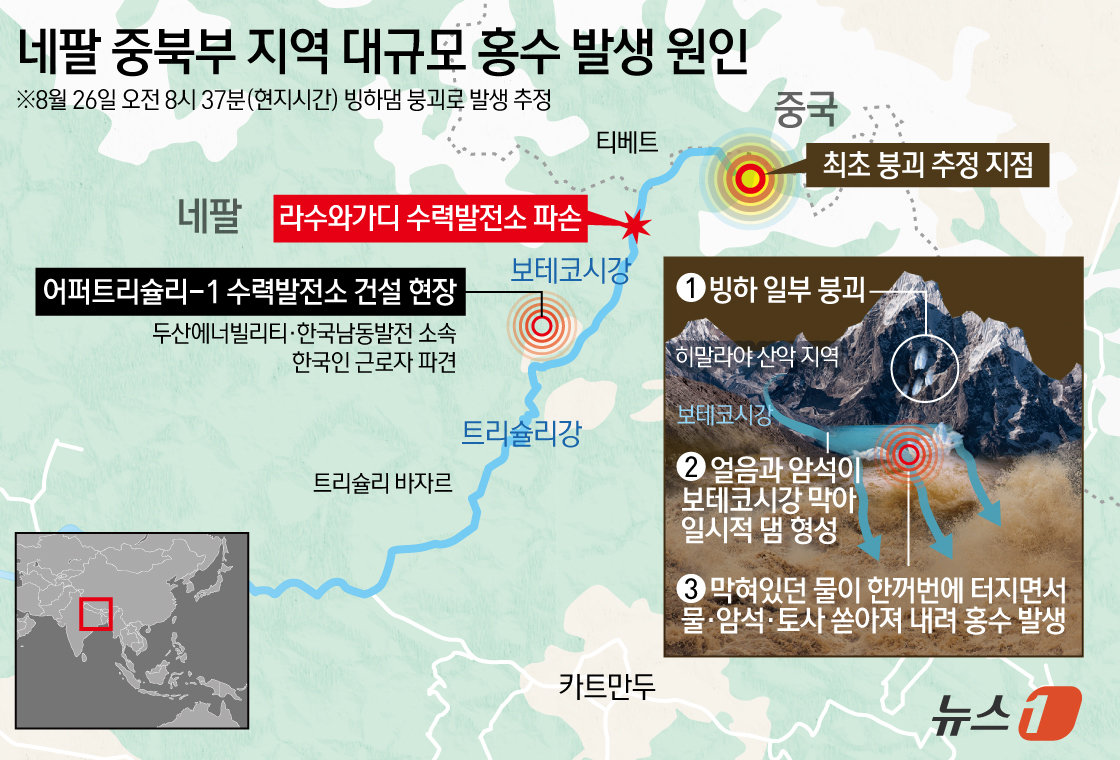
Rhomjon, 27, who has been active in climate change and disaster risk reduction since his hometown was severely damaged by a glacial lake outburst flood in 2011, emphasized in a written interview that the current disaster is merely a "small sign of climate collapse." The floods were reportedly caused by a massive glacial collapse on the LangtangLirung mountain near the Nepal-China border, which blocked the Rendhe River. The resulting water surge breached the dam, inundating downstream residential areas.
The scale of the disaster has deeply affected Nepal, a country that experiences annual disasters like glacial lake floods, floods, and landslides. "While Kathmandu was not directly affected, the impact of the disaster is felt very strongly here too," Rhomjon stated. "There is shock, grief, and anxiety due to the large number of missing people." He added that communication and transportation networks in the affected Rasuwa region were largely destroyed, hindering rescue and relief efforts. The cost of infrastructure damage and reconstruction far exceeds Nepal's capacity.
What happened in Nepal is just a very small sign of climate collapse.
Rhomjon is convinced the disaster is linked to global warming, explaining that as glaciers melt and flow into rivers, they cause flash floods. He cited a 2023 report by the International Centre for Integrated Mountain Development (ICIMOD) based in Kathmandu, which warned that Himalayan glaciers could lose up to 80% of their volume by 2100 if current greenhouse gas emission trends continue, leading to increased floods and landslides in the coming decades.
Nepal experiences disasters like glacial lake floods, floods, and landslides every year, but disasters of this magnitude are not common.
"Nepal's carbon emissions are close to zero globally. We Nepalis are paying the price for a climate crime we did not commit," Rhomjon asserted. He also expressed concern for nine South Koreans, including three from Korea South-East Power and six from Doosan Enerbility, who went missing while working on the Upper Trishuli-1 (UT-1) hydropower project. This project, crucial for Nepal's energy security and economic development, was expected to supply about 20% of the country's total electricity. Rhomjon appealed for international cooperation, calling for robust early warning systems, climate-resilient infrastructure, and better glacier monitoring.
The infrastructure damage and reconstruction costs are beyond our capabilities.
About this summary
Originally published by Hankyoreh in Korean. Translated, summarized, and contextualized automatically by DistantNews, with a note on how the source frames the story. Not individually reviewed before publishing. How this works.
More Stories


From Our Blog

What Gets Lost (and Found) When News Is Translated

The Critical Role of Diaspora Media in Global News

What Travellers Should Know About Countries with Restricted Press

A Digital Nomad's Guide to Following Local News

How the Same Story Looks Different in Different Countries
