


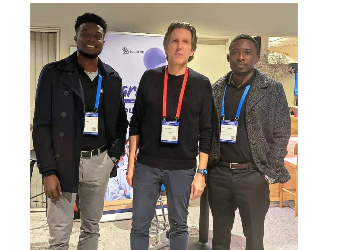
Nigerian Brothers' Edugene Joins European Genomic Medicine Consortium, Boosting Science Education in Africa
Translated from English, summarized and contextualized by DistantNews.
At a glance
News
Named sources
Context piece
- Nigerian brothers Davis and Emmanuel Eban founded Edugene, a science and biotechnology education startup.
- Edugene has been admitted into the European Genomic Medicine Consortium (EGMEDC), marking a first for an African organization.
- This admission is expected to create opportunities for African students to engage with European research, labs, and internships, bridging the gap between theoretical knowledge and practical skills.
Nigerian brothers Davis and Emmanuel Eban are making waves in science education across Africa with their startup, Edugene. The organization, focused on life sciences and biotechnology, has achieved a significant international milestone by becoming the first African entity admitted into the European Genomic Medicine Consortium (EGMEDC).
The admission, formalized in April 2026 at the CRISPRMED26 Conference in Copenhagen, Denmark, opens doors for African students. They can now anticipate greater access to European laboratories, research projects, mentorship, and international internships. Edugene aims to bridge the gap between academic learning and the practical experience crucial in fields like genomics, bioinformatics, and molecular biology.
Edugene's inclusion in EGMEDC also grants it access to a broad network of European organizations involved in genomic medicine and CRISPR technology. CRISPR, a gene-editing tool, is revolutionizing biological research and the treatment of genetic diseases. EGMEDC itself is a non-profit consortium dedicated to advancing CRISPR and genomic medicine applications in Europe, supported by leading institutions.
For the Eban brothers, this achievement transcends mere membership in a European network. They view it as a vital opportunity to forge practical connections between African students and the global scientific community. Davis Eban, Edugene's CEO and a cell biologist, explained that the platform originated from observing a recurring problem: brilliant African students lacking pathways to practical experience. "We kept seeing brilliant African students with no pathway," he stated, highlighting the disparity between theoretical knowledge gained in Nigerian universities and the hands-on skills demanded by research institutions and biotech companies.
We kept seeing brilliant African students with no pathway.
DistantNews Editorial
Originally published by Vanguard in English. Translated, summarized, and contextualized by our editorial team with added local perspective. Read our editorial standards.
More Stories


From Our Blog

How the Same Story Looks Different in Different Countries

What Gets Lost (and Found) When News Is Translated

The Critical Role of Diaspora Media in Global News

What Travellers Should Know About Countries with Restricted Press

A Digital Nomad's Guide to Following Local News
