


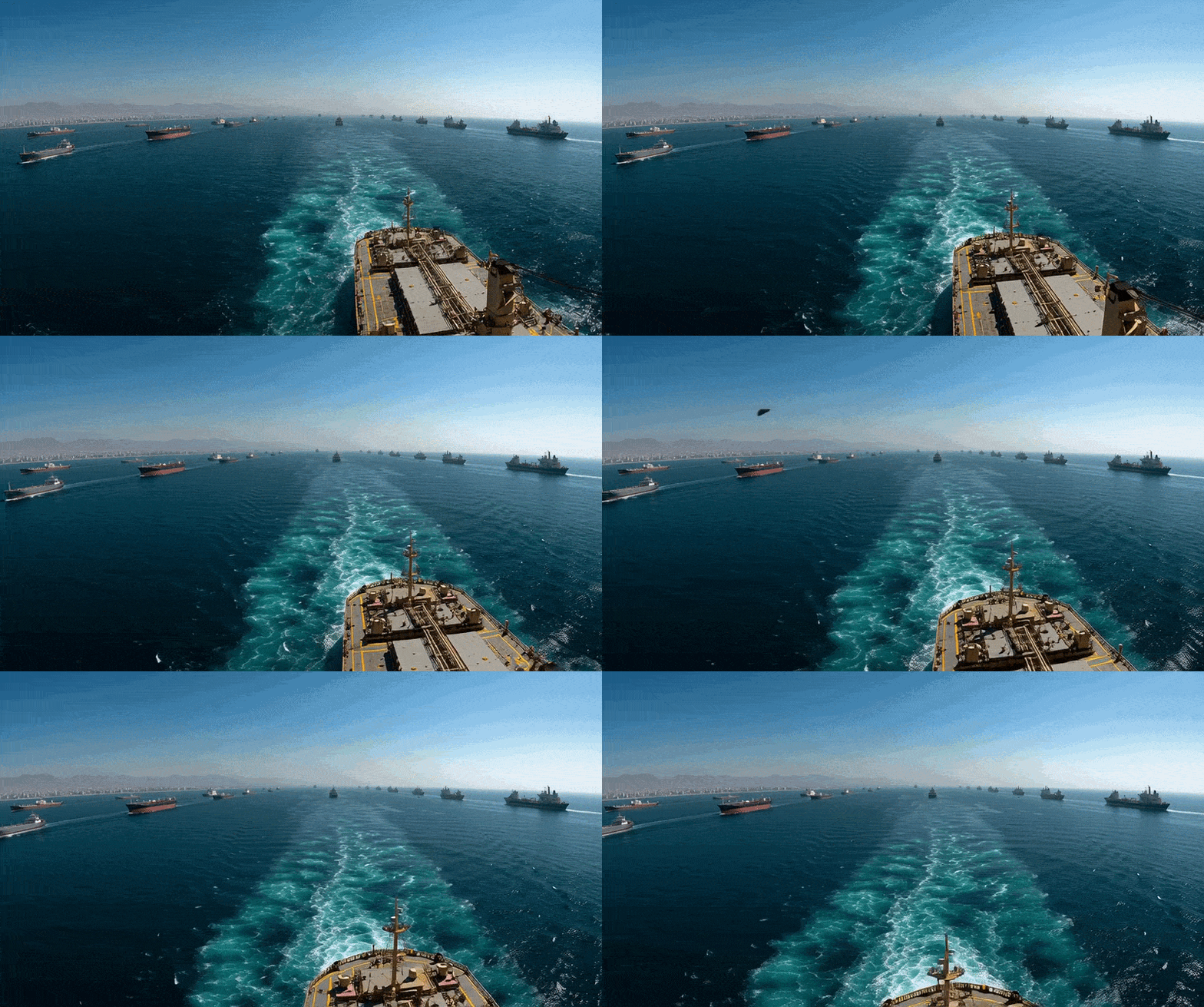
No Strait answer: Can international law stay afloat in Hormuz?
Summarized and contextualized by DistantNews.
TLDR
- The US has threatened to blockade the Strait of Hormuz, a move that defies international law and logic, as Iran has already effectively shut it down.
- International maritime and security law experts are weighing in on the implications of the US threat, particularly concerning the UN Convention on the Law of the Sea (UNCLOS).
- Experts argue that UNCLOS provisions, even for non-signatories like the US and Iran, have become customary international law, binding states regardless of formal consent.
The recent pronouncements from Washington regarding the Strait of Hormuz present a bewildering paradox. President Trump's declaration of a "BLOCKADE" on this vital waterway, delivered with his characteristic all-caps emphasis, raises more questions than it answers. Given that Iran has, by all accounts, already effectively halted maritime traffic, the logic of a US blockade appears to defy conventional understanding and international legal frameworks.
the more loudly someone claims to control it, the more obvious it becomes that nobody really does.
This situation is further complicated by the fact that neither the United States nor Iran are signatories to the 1982 UN Convention on the Law of the Sea (UNCLOS). However, as legal scholars point out, many of its core provisions have evolved into customary international law. This means that even without formal ratification, states may still be bound by these established norms, which are shaped by consistent state practice and a sense of legal obligation.
either every ship sails freely, or none do.
The implications for freedom of navigation and international trade are significant. The Strait of Hormuz is a critical chokepoint, and any unilateral action to control or blockade it risks escalating tensions and disrupting global energy supplies. The legal complexities surrounding transit passage rights, designed to prevent such unilateral control, are now at the forefront as the world grapples with a threat that seems to operate outside established legal and logical boundaries.
Can any state, however powerful, seal off a chokepoint governed by transit passage rights designed to prevent precisely this kind of unilateral control?
DistantNews Editorial
Originally published by Dawn. Summarized and contextualized by our editorial team with added local perspective. Read our editorial standards.
More Stories

From Our Blog

What Gets Lost (and Found) When News Is Translated

The Critical Role of Diaspora Media in Global News

What Travellers Should Know About Countries with Restricted Press

A Digital Nomad's Guide to Following Local News

How the Same Story Looks Different in Different Countries
