


Nobility Buried at Naumburg Cathedral: Archaeologists Discover Graves
Translated from German, summarized and contextualized by DistantNews.
At a glance
News
From a news agency
Context piece
- Archaeologists have uncovered an 11th-century cemetery near the Naumburg Cathedral in Germany.
- The site contains 13 well-preserved burials, believed to belong to the era's social elite, with some individuals interred in elaborate stone caskets.
- Ongoing research, including DNA analysis, aims to reveal details about the relationships, origins, and lives of these historical figures.
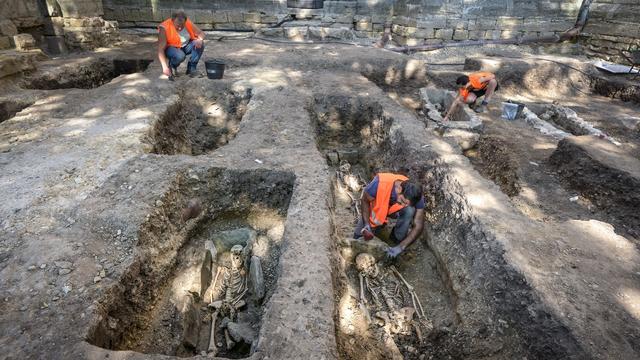
An 11th-century cemetery, believed to house members of the social elite, has been unearthed by archaeologists near the Naumburg Cathedral in Germany. The discovery was made during extensive redevelopment work on the cathedral square. This extensive investigation marks the first time such a burial ground from this period has been thoroughly examined using modern scientific methods.
It is the first time that such a burial field is being comprehensively investigated.
Among the 13 documented burials, five individuals were found interred in meticulously constructed stone caskets. These caskets featured side walls made of large stone slabs, joined with lime mortar, and were sealed with wooden boards before the graves were filled. Two additional bodies were also placed in stone caskets, though their stone slabs were set without mortar. Other graves included stone slabs at the head and foot ends. The interred individuals include men, women, adolescents, and a toddler approximately one year old, who was buried posthumously in a stone casket already occupied by another person, suggesting a possible close familial relationship.
Archaeologists noted that the graves rarely overlap, and when they do, it is only at the edges. This suggests that the burial sites were originally marked above ground and that the cemetery was used for a relatively short period. The construction of the graves, some of which were built over by the late Romanesque cathedral erected around 1210, indicates that these burials date back to the 11th century. The elaborate construction and the cemetery's prime location between two sacred buildings, directly in front of the cathedral's main entrance, strongly indicate that the deceased belonged to the contemporary nobility.
The construction of the graves, as well as their partial overbuilding by the late Romanesque cathedral built from around 1210, indicates that the burials belong to the 11th century.
The recovered skeletons are undergoing anthropological examination, with plans for DNA analysis at the Max Planck Institute for Evolutionary Anthropology in Leipzig. These studies are expected to shed light on potential kinship ties, the origins, and the life circumstances of the buried individuals. This research is part of a long-term initiative by the State Office for Heritage Management and Archaeology of Saxony-Anhalt to investigate early medieval elites.
In the opinion of Rode, the people buried there undoubtedly belonged to the contemporary nobility.
DistantNews Editorial
Originally published by Die Zeit in German. Translated, summarized, and contextualized by our editorial team with added local perspective. Read our editorial standards.
More Stories



From Our Blog

What Gets Lost (and Found) When News Is Translated

How the Same Story Looks Different in Different Countries

The Critical Role of Diaspora Media in Global News

What Travellers Should Know About Countries with Restricted Press

A Digital Nomad's Guide to Following Local News
