

OSCE report on Russia's indoctrination in occupied territories: 'Even more and younger children reached'
Translated from German, summarized and contextualized by DistantNews.
At a glance
Analysis
Named sources
Context piece
- A new report details systematic human rights violations by Russia in occupied Ukrainian territories, focusing on the indoctrination of children.
- Russia reportedly uses the education system as a tool for militarization and to instill pro-Russian patriotism.
- The report highlights the rapid implementation of these policies, using Crimea as a testing ground.
A comprehensive 129-page report presented to the Organization for Security and Cooperation in Europe (OSCE) in Vienna details extensive human rights violations by Russia in occupied Ukrainian territories. Three independent experts meticulously document how Russia is systematically re-educating children and adolescents to become patriotic Russians, effectively using the education system as a tool for militarization and indoctrination.
For Russia, the education system is an instrument of militarization and indoctrination.
"For Russia, the education system is an instrument of militarization and indoctrination," stated Hervé Ascensio, a professor of international law and one of the report's authors, during a press briefing. The report covers a wide range of school and extracurricular activities affecting an estimated 1.6 million children and adolescents in occupied areas, including Crimea. Patriotic lessons align students with the Kremlin's political objectives, while Russian historical narratives dominate textbooks, questioning Ukraine's statehood. Ukrainian language instruction has reportedly been abolished.
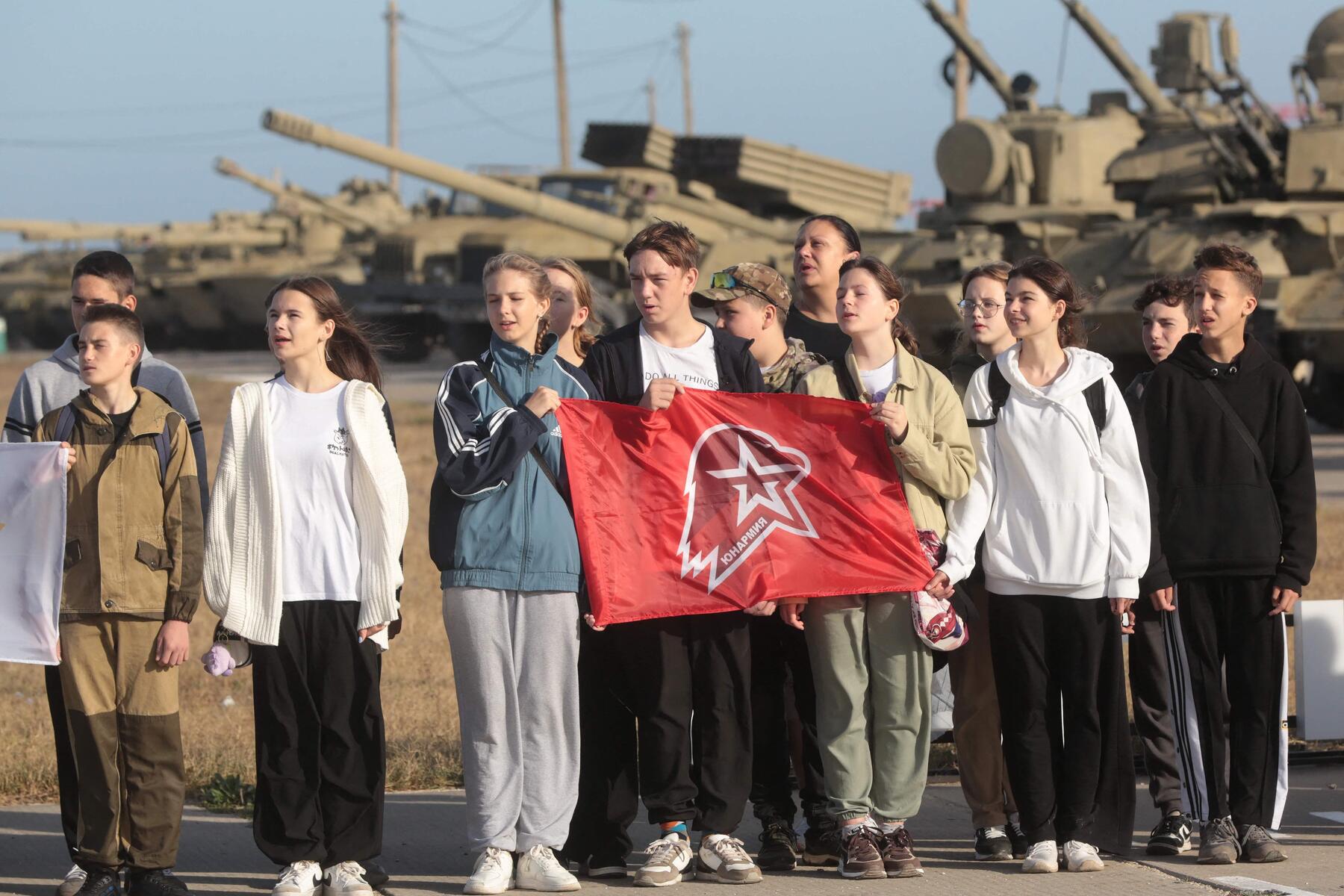
"Russia does not see education as a neutral good, but as part of state security," explained Elīna Šteinerte, a study author and human rights lawyer. Beyond ideological indoctrination, military-patriotic activities have become commonplace amidst ongoing hostilities. Children are learning to handle weapons and operate drones under the guidance of war veterans and soldiers in so-called cadet classes, preparing them for future military careers. Pro-Kremlin youth organizations, such as Putin's "Movement of the First" and the "Youth Army," have been rapidly established in the occupied territories.
Russia does not see education as a neutral good, but as part of state security.
The experts emphasize Crimea's role, annexed in 2014, as a "laboratory" for ideological re-education. "The initially improvised policy in Crimea has evolved into an extensive system reaching even more and younger children," said Stefan Wolff, a study author and professor of international security. Wolff also noted the Russian state's learning curve in its passportization policy, which took four years in Crimea but only four months in the newly occupied territories, indicating a tested and accelerated implementation process.
The initially improvised policy in Crimea has evolved into an extensive system reaching even more and younger children.
DistantNews Editorial
Originally published by Die Presse in German. Translated, summarized, and contextualized by our editorial team with added local perspective. Read our editorial standards.
More Stories


From Our Blog

What Gets Lost (and Found) When News Is Translated

The Critical Role of Diaspora Media in Global News

What Travellers Should Know About Countries with Restricted Press

A Digital Nomad's Guide to Following Local News

How the Same Story Looks Different in Different Countries
