


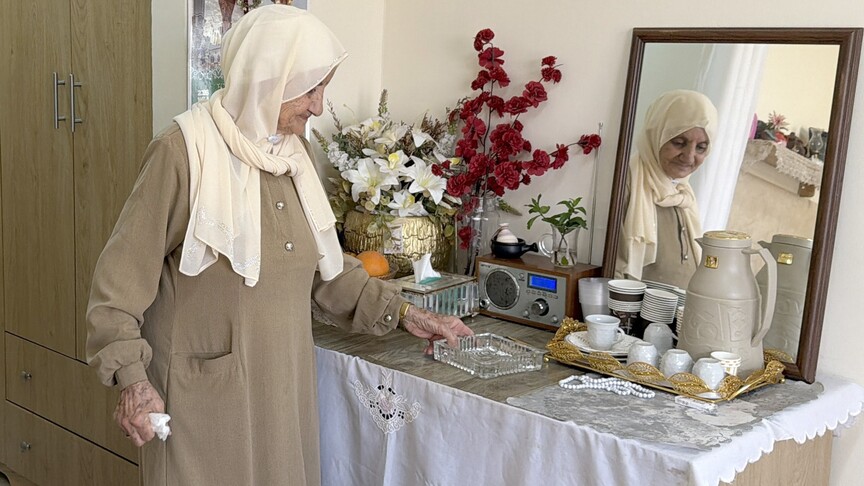
Palestinian woman experiences Nakba trauma twice after displacement from Jenin camp
Translated from Malay, summarized and contextualized by DistantNews.
At a glance
News
Named sources
Context piece
- An 83-year-old Palestinian woman, Rahma Hammad, recounts experiencing the Nakba twice after being displaced from her home in the Jenin refugee camp.
- She was first forced from her village of al-Sindiyana near Haifa in 1948 during the Nakba and again recently due to Israeli military operations.
- The Nakba, meaning
Rahma Abdul Razzaq Hammad, an 83-year-old Palestinian woman, has lived through the Nakba twice, a profound tragedy that has marked her life with displacement and loss. The first time was in 1948 when her family was driven from their home in al-Sindiyana, a village near Haifa. More than seven decades later, she found herself forced to flee her home in the Jenin refugee camp once more due to Israeli military operations.
From a small room in the town of Zababdeh, southeast of Jenin, Hammad shared her memories with Anadolu Agency on the 78th anniversary of the Nakba. She described her life as a dejavu, with the initial expulsion occurring when she was a child. Her suffering began in al-Sindiyana and continues as Palestinian families are still being displaced from the Jenin refugee camp. The Israeli military's operation in the northern West Bank, which began on January 21, 2025, in Jenin and expanded to Tulkarm and Nur Shams, has destroyed hundreds of homes and displaced over 50,000 Palestinians.
The Nakba, meaning "catastrophe" in Arabic, refers to the events surrounding Israel's declaration of establishment on Palestinian land on May 15, 1948. The Zionist regime's actions led to mass killings and the expulsion of Palestinians from their homes. Palestinians commemorate the Nakba annually on May 15 with marches, events, and exhibitions worldwide, demanding their rights, including the right of return for millions of refugees.
Hammad recalled her family's journey from al-Sindiyana when she was less than five years old. They walked away from their village in fear and chaos, moving from place to place before arriving at the Jenin refugee camp. After their expulsion, her family moved frequently, eventually settling in a tent in the Janzour area south of Jenin, while other Palestinian families were separated and sought refuge elsewhere. Despite the passage of decades, the memories of her homeland remain vivid. She had the chance to revisit her village for the first time after the 1967 war. "After 1967, we were able to enter and visit the village. As soon as I got out of the car, I picked three wild taro leaves from the ground. At that moment, I felt as if the whole village was in the palm of my hand," she said.
After 1967, we were able to enter and visit the village. As soon as I got out of the car, I picked three wild taro leaves from the ground. At that moment, I felt as if the whole village was in the palm of my hand.
DistantNews Editorial
Originally published by Utusan Malaysia in Malay. Translated, summarized, and contextualized by our editorial team with added local perspective. Read our editorial standards.
More Stories



From Our Blog

What Gets Lost (and Found) When News Is Translated

The Critical Role of Diaspora Media in Global News

What Travellers Should Know About Countries with Restricted Press

A Digital Nomad's Guide to Following Local News

How the Same Story Looks Different in Different Countries
