

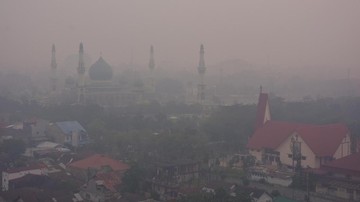

Pekanbaru Haze Cuts Visibility to 2 Kilometers as Air Quality Turns Hazardous
Summarized and contextualized by DistantNews.
At a glance
News
Named sources
Ongoing story
- Pekanbaru City is experiencing hazardous air quality due to dense haze, with visibility reduced to approximately 2 kilometers.
- The haze is caused by widespread forest and land fires across Sumatra, particularly in Riau Province, which recorded 393 hotspots.
- The air quality in Pekanbaru reached a peak PM2.5 reading of 508.8 micrograms per cubic meter, indicating a severe health hazard.
Pekanbaru City is currently blanketed in dense haze, severely impacting visibility and air quality. The Indonesian Meteorology, Climatology, and Geophysics Agency (BMKG) Pekanbaru Station reported that visibility has dropped to about 2 kilometers, with air quality reaching hazardous levels.
Forecaster Ranti Kurniati stated that these figures were based on data updated since Monday afternoon. Visibility in Pekanbaru and Rengat was recorded at 2 km, while Pelalawan saw 5 km and Tambang 3 km, all affected by haze. The air quality in Pekanbaru City, measured by PM2.5 levels, entered the hazardous range early Tuesday morning, peaking at 508.8 micrograms per cubic meter at 1:00 AM Western Indonesian Time.
The haze is a direct consequence of extensive forest and land fires across Sumatra. On Monday, a total of 2,193 hotspots were detected throughout the island. South Sumatra recorded the highest number with 1,207 hotspots, followed by Riau Province with 393. Within Riau, Pelalawan Regency had the most hotspots (153), followed by Indragiri Hilir Regency (140).
The largest active fire is in Pelalawan Regency, covering 700 hectares, with other significant fires in Indragiri Hulu (471 hectares) and tens of hectares in Indragiri Hilir and Kampar. These fires are contributing to the widespread haze affecting visibility and air quality in the region and neighboring areas.
Visibility was observed at 2 km in Pekanbaru City (hazy) and Rengat (hazy), while Pelalawan recorded 5 km and Tambang 3 km, both with haze.
DistantNews Editorial
Originally published by Tempo. Summarized and contextualized by our editorial team with added local perspective. Read our editorial standards.
More Stories


From Our Blog

What Gets Lost (and Found) When News Is Translated

The Critical Role of Diaspora Media in Global News

What Travellers Should Know About Countries with Restricted Press

A Digital Nomad's Guide to Following Local News

How the Same Story Looks Different in Different Countries
