


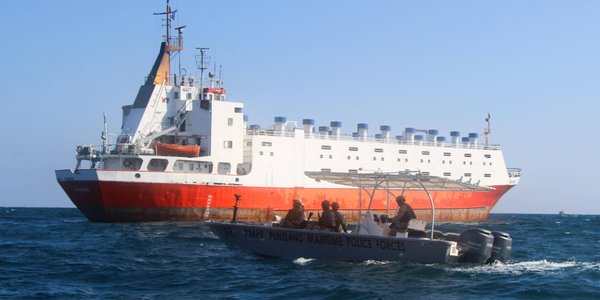
Pirates return to Somali waters amid chaos from US-Iran war
Translated from Polish and summarized by DistantNews. Read the original for the full story.
At a glance
Analysis
Named sources
Ongoing story
- Somali pirates seized two vessels in four days last week, while at least 13 ships have been attacked since the start of the year.
- Experts say conflicts around the Strait of Hormuz and Bab al-Mandab may have diverted international maritime forces and created opportunities for pirates.
- Activity remains below the 2011 peak, but piracy networks persist amid insecurity, economic hardship and local anger over foreign fishing.
Somali piracy is exploiting a new opening created by wider maritime tensions, according to Omar Mahmood, a senior Somalia analyst at the International Crisis Group. “Piracy is always a crime that exploits opportunity, and pirates see such an opportunity now,” he said.
The opportunity lies farther north. The United States and Iran are fighting for control of the strategic Strait of Hormuz, while Iran-backed Houthi forces in Yemen have restricted shipping through Bab al-Mandab, the passage leading to the Red Sea. Those restrictions have added uncertainty for shipowners.
European naval operation commander Vice Admiral Ignacio Villanueva Serrano said pirates may believe international forces are focusing on the crises around Hormuz and Bab al-Mandab rather than pursuing them. The recent attacks include the Cameroon-flagged MV Lutuf, seized off semi-autonomous Puntland on Aug. 17, and the Eritrean-flagged oil-products tanker MT Sibu 1, attacked near Yemen. Lutuf was later released, although the circumstances remain unclear.
Piracy is always a crime that exploits opportunity, and pirates see such an opportunity now.
Two drone attacks followed within a week of the hijacking, killing 13 men suspected of supplying pirates. No group officially claimed responsibility. Local authorities accused Turkey, saying Turkish weapons were aboard the vessel.
The pirates were reportedly holding six ships and demanding multimillion-dollar ransoms. Four vessels were said to be anchored near Bander Beyla, a fishing town long associated with Somali piracy. The current scale remains far below 2011, when pirates carried out more than 200 attacks and held hundreds of crew members hostage. International naval coordination and private security teams later reduced the threat, though activity rose again in 2023 and 2024. Experts say the networks weakened but never disappeared, helped by insecurity, economic problems and local frustration over foreign trawlers fishing in Somali waters.
I suppose the pirates decided that, given events in Hormuz and Bab al-Mandab, international forces would be more engaged in these crises than in chasing pirates.
About this summary
Originally published by Rzeczpospolita in Polish. Translated, summarized, and contextualized automatically by DistantNews, with a note on how the source frames the story. Not individually reviewed before publishing. How this works.
More Stories



From Our Blog

What Gets Lost (and Found) When News Is Translated

The Critical Role of Diaspora Media in Global News

What Travellers Should Know About Countries with Restricted Press

A Digital Nomad's Guide to Following Local News

How the Same Story Looks Different in Different Countries
