


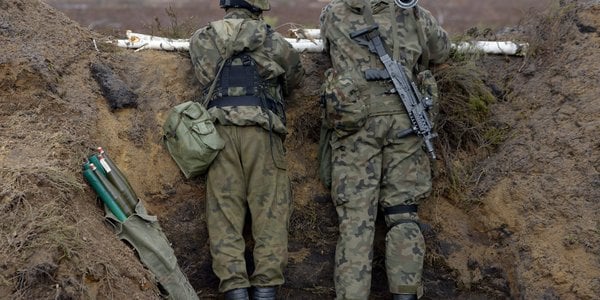
Poland Considers Life Sentence for Disobeying Orders in Combat
Translated from Polish, summarized and contextualized by DistantNews.
At a glance
News
Sources not specified
New plan
- Poland is considering stricter penalties for soldiers who disobey orders during wartime, including potentially life imprisonment for refusing combat commands.
- Current military criminal code provisions are deemed insufficient for wartime scenarios, prompting a review by the Ministry of Justice.
- Experts recommend adapting laws to reflect the increased importance of discipline in active combat situations.
Poland is contemplating significant changes to its military penal code to address the perceived inadequacy of existing laws in wartime. The push for stricter penalties stems from concerns that current regulations, primarily designed for peacetime discipline, are insufficient to handle insubordination during active combat.
The existing regulations contained in the military part of the penal code, aimed primarily at maintaining soldierly discipline in peacetime, do not contain adequate solutions for wartime.
National Prosecutor Dariusz Korneluk highlighted the issue in a letter to the Minister of Justice last autumn, stating that existing provisions in the military part of the penal code do not offer adequate solutions for wartime. He emphasized the "urgent need for legislative action to develop comprehensive solutions within the broadly understood criminal law" to fill this gap. While Korneluk identified the problem, he did not propose specific changes.
In response, the Ministry of Justice tasked the Codification Commission of Criminal Law with analyzing the regulations and developing new solutions. The commission's opinion, now with the ministry, confirms that current criminal laws criminalizing violations of military discipline were created for peacetime. The intention was for wartime law to be defined in a separate legal act, which was never created.
There is an urgent need to take legislative action aimed at developing comprehensive solutions, within the broadly understood criminal law (...), filling the revealed gap.
Under the current penal code, soldiers face penalties such as military arrest or up to three years in prison for failing to execute or refusing an order, or executing it incorrectly. More severe penalties, ranging from three months to five years in prison, apply if the soldier acts jointly with others or if the insubordination causes significant damage. If committed in concert with others, the penalty can be up to two years in prison. The decision to prosecute refusal of an order rests with the unit commander.
It is beyond doubt that the importance of discipline (punishment) increases immeasurably not so much in wartime or threat of war, but above all in a combat situation, thus, the reprehensibility of acts infringing upon this legal good increases in such a situation.
The Codification Commission argues that these provisions need revision to align with the realities of fighting an enemy. They noted that the importance of discipline "immeasurably increases not so much in wartime or threat of war, but above all in a combat situation." Therefore, they believe it is justified to introduce a provision, similar to the 1969 penal code, that toughens criminal liability for a soldier's disobedience of an order in a combat situation. This could potentially lead to penalties as severe as life imprisonment for refusing a combat order.
In the assessment of the commission, this justifies the introduction – following the example of the 1969 penal code – of a provision stiffening criminal liability for a soldier's disobedience of an order in a combat situation.
DistantNews Editorial
Originally published by Rzeczpospolita in Polish. Translated, summarized, and contextualized by our editorial team with added local perspective. Read our editorial standards.
More Stories


From Our Blog

What Gets Lost (and Found) When News Is Translated

The Critical Role of Diaspora Media in Global News

What Travellers Should Know About Countries with Restricted Press

A Digital Nomad's Guide to Following Local News

How the Same Story Looks Different in Different Countries
