


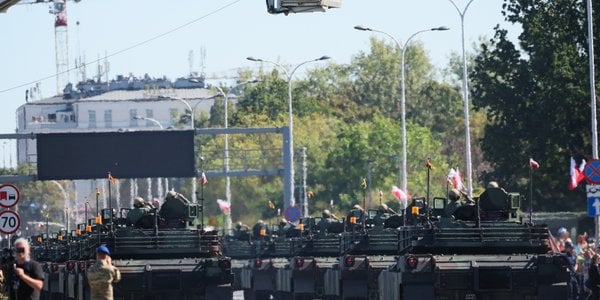
Poland's defense spending: Innovation over parades for economic growth
Translated from Polish, summarized and contextualized by DistantNews.
At a glance
Analysis
Sources not specified
Context piece
- Poland's defense spending is increasing significantly, with over 170 billion PLN allocated.
- The author argues that genuine technological innovation and domestic industry, not just parade displays or purchasing foreign equipment, are crucial for both military strength and civilian economic growth.
- The success of the Polish Piorun missile is presented as evidence that domestic innovation can lead to both military and economic benefits.
Poland's substantial defense budget increase, exceeding 170 billion PLN, prompts a critical look beyond military parades. The author contends that true technological advancement, essential for both national security and civilian economic progress, stems from domestic industry and innovation, not merely from acquiring foreign-made equipment or showcasing impressive displays.
Almost makes a big difference.
While military parades may dazzle the public with the might of marching boots and roaring engines, they obscure a fundamental truth: "almost" makes a big difference. The article criticizes the focus on outward appearances, suggesting that well-equipped armies that solely rely on purchased hardware and lack indigenous technological development risk obsolescence. This reliance on foreign arms, it argues, does not foster the innovation needed to improve Poland's civilian production and global market competitiveness.
Everyone who has had even a little to do with the economy knows that one of the most important drivers of technical innovation in all its fields is armaments, based on one's own industry, not on buying ready-made equipment.
The piece highlights the "unexpected career" of the Polish "Piorun" anti-aircraft missile, which has proven effective in conflicts and is slated for purchase by several EU nations. This success is presented as a testament to Poland's potential to develop advanced weaponry. The author poses a crucial question: will this military innovation translate into better everyday products like refrigerators, cars, and electronics? The article implies that without a focus on technology transfer and indigenous invention, Poland risks remaining a supplier of cheap labor and a location for manufacturing plants, rather than a hub of innovation.
Without it – in 30-40 years – you will have to buy the same thing again, only probably more expensive.
The author draws a stark contrast between military procurement and democratic processes, suggesting that in the military sphere, there is a unique "glorious" approach. The core message is that Poland must move beyond simply buying what is available from major powers and focus on developing its own technological capabilities. This shift is seen as vital for improving both its defense posture and its broader economic standing on the world stage.
Without access to technology and, above all, without our own inventions, we will not improve civilian production, which serves us and which we are trying to sell on world markets.
DistantNews Editorial
Originally published by Rzeczpospolita in Polish. Translated, summarized, and contextualized by our editorial team with added local perspective. Read our editorial standards.
More Stories



From Our Blog

What Gets Lost (and Found) When News Is Translated

The Critical Role of Diaspora Media in Global News

What Travellers Should Know About Countries with Restricted Press

A Digital Nomad's Guide to Following Local News

How the Same Story Looks Different in Different Countries
