

Polar Bear's 'Workout' with Ice Floe Captures Attention in Arctic
Translated from Romanian, summarized and contextualized by DistantNews.
At a glance
In-depth
Sources not specified
Context piece
- A polar bear was filmed using an ice floe as a weight during an unusual 'workout' session in the Arctic.
- The bear was seen stretching on its back, lifting the ice, and then gracefully swimming into the water.
- The photographer noted this 'amphibious routine' was a first for him, having previously seen bears doing 'Pilates' on land.
- Climate change is noted as a factor influencing polar bear genetics and adaptation to warmer conditions.
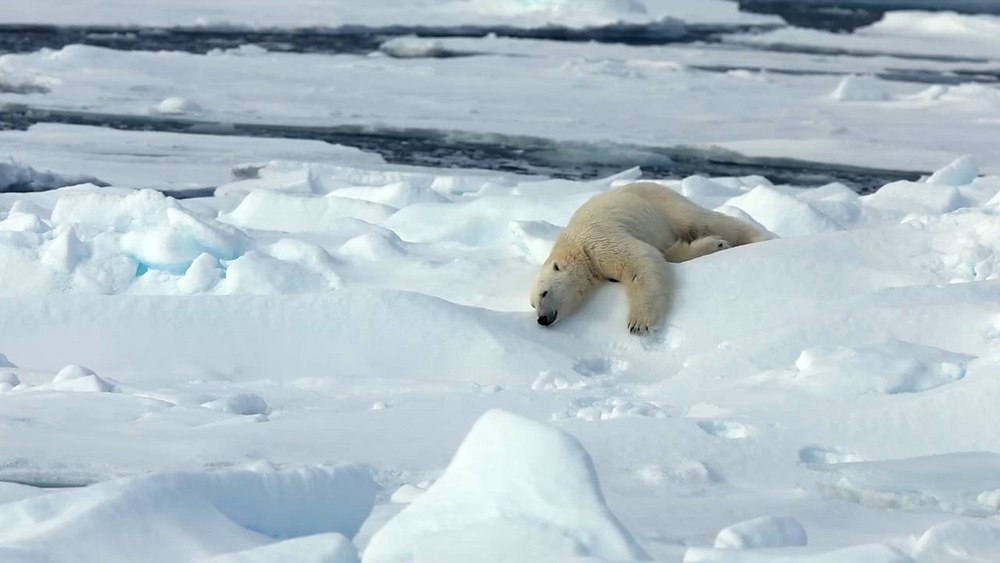
An extraordinary display of what appears to be a polar bear engaging in a unique 'workout' has been captured on video off the coast of Norway's Svalbard archipelago. The footage shows the large mammal lying on its back, seemingly using a block of ice as an improvised weight for an exercise routine.
Following its apparent strength training, the bear then gracefully slid into the frigid Arctic waters for a swim. Paul Goldstein, the photographer who documented the unusual scene, described the moment as a first for him. "I've seen bears do 'Pilates' on dry land before, but the amphibious routine was something new for me," he shared in an Instagram post, highlighting the unexpected nature of the bear's behavior.
I've seen bears do 'Pilates' on dry land before, but the amphibious routine was something new for me.
This behavior occurs against a backdrop of significant environmental changes in the Arctic. According to The Conversation, climate warming is causing observable changes in polar bears' genetic activity, some of which may aid their adaptation to warmer climates. The Arctic Ocean is currently experiencing its highest temperatures in 125,000 years, with temperatures continuing to rise.
Scientists estimate that over two-thirds of polar bears could disappear by 2050, and the species might face complete extinction by the end of this century. While DNA can adapt and evolve gradually, environmental stressors like climate change can accelerate this process. Researchers have observed massive activation of transposable elements (TEs), or 'jumping genes,' in polar bears, particularly in response to higher temperatures. These genetic shifts might help polar bears cope with more challenging environmental conditions and periods of scarce food, potentially enabling them to adapt to diets richer in plants rather than solely relying on fat-rich seals.
A small ship, without a set schedule, just hours spent forcing a look through binoculars in the middle of the sea ice... bingo!
DistantNews Editorial
Originally published by Adevărul in Romanian. Translated, summarized, and contextualized by our editorial team with added local perspective. Read our editorial standards.
More Stories


From Our Blog

What Gets Lost (and Found) When News Is Translated

The Critical Role of Diaspora Media in Global News

What Travellers Should Know About Countries with Restricted Press

A Digital Nomad's Guide to Following Local News

How the Same Story Looks Different in Different Countries
