


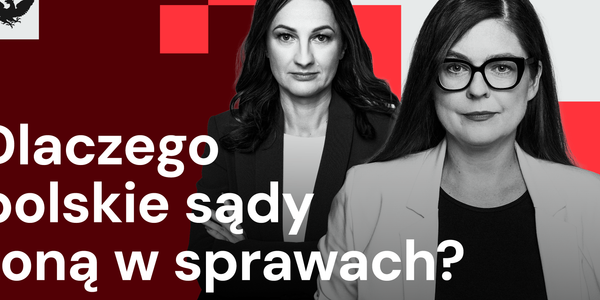
Poles Love to Sue; Mediation is Like Bigfoot, Says Expert
Translated from Polish and summarized by DistantNews. Read the original for the full story.
At a glance
News
Sources not specified
Context piece
- Poland's judiciary faces ongoing political conflict between the government and the president, impacting judicial appointments and reforms.
- The new Supreme Court president proposed a solution for the long-standing dispute over neo-judges, but it requires political intervention.
- Polish citizens frequently resort to lawsuits, with mediation remaining an underutilized alternative for resolving disputes outside of court.
Poland's judicial system is grappling with a complex web of political disputes and an overreliance on litigation, according to legal expert Ewa Szadkowska.
A key point of contention is the recent nomination of Zbigniew Kapiński as the First President of the Supreme Court by President Andrzej Duda. This decision has drawn sharp criticism from some conservative circles, primarily due to Kapiński's involvement 26 years ago in a ruling concerning Lech Wałęsa's lustration declaration. Szadkowska noted that the controversy stems from this past decision, highlighting the deep divisions within the legal and political landscape.
The long-standing debate over the status of "neo-judges" also remains unresolved. While the new First President has suggested a potential solution, Szadkowska believes the issue has transcended legal boundaries and can only be settled by politicians. She expressed skepticism about the effectiveness of a single law to end the chaos surrounding judicial appointments, suggesting that no ideal solution currently exists.
Adding to the complexity, presidential vetoes have become a regular feature of Poland's legislative process, creating uncertainty. Szadkowska described the "veto machine" as akin to a lottery, where the president's decisions are unpredictable. The discussion also touched upon the case of former Justice Minister Zbigniew Ziobro, raising questions about the state's efficacy. Paradoxically, Szadkowska pointed out that if the justice minister, who significantly influenced judicial reforms, fears the justice system, it might indicate its continued independence.
Szadkowska further highlighted that Polish courts are overloaded not only by judicial reforms and political conflicts but also by the sheer volume of cases that could be resolved outside the courtroom. "Poles like to sue," she observed, suggesting a cultural preference for formal judgments over alternative dispute resolution. Mediation, she lamented, remains as elusive as the mythical Yeti – widely discussed but rarely seen, as people prefer conflict over compromise. The conversation also briefly explored the impact of artificial intelligence on legal professions, with Szadkowska predicting AI will handle simpler tasks but not replace experienced legal professionals.
About this summary
Originally published by Rzeczpospolita in Polish. Translated, summarized, and contextualized automatically by DistantNews, with a note on how the source frames the story. Not individually reviewed before publishing. How this works.
More Stories



From Our Blog

What Gets Lost (and Found) When News Is Translated

The Critical Role of Diaspora Media in Global News

What Travellers Should Know About Countries with Restricted Press

A Digital Nomad's Guide to Following Local News

How the Same Story Looks Different in Different Countries
