


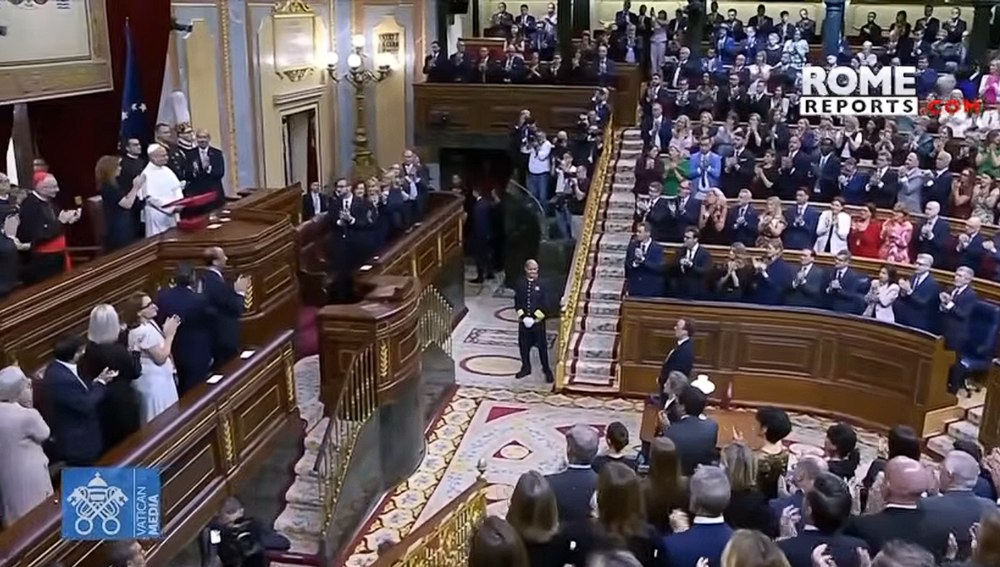
Pope Leo XIV warns Spanish Parliament of global crisis, calls for peace and ethical vigilance
Translated from Romanian, summarized and contextualized by DistantNews.
At a glance
News
Sources not specified
Context piece
- Pope Leo XIV delivered a historic address to the Spanish Parliament, warning of a profound global spiritual and cultural crisis.
- He criticized escalating conflicts and rising military spending, advocating for diplomatic solutions and peace.
- The Pope also addressed migration as a moral challenge and called for ethical vigilance regarding new technologies like artificial intelligence.
Pope Leo XIV delivered a historic and powerful address to the Spanish Parliament, receiving an unprecedented seven-minute standing ovation. In what is considered one of his most extensive and politically charged speeches to date, the Pontiff issued a stern warning about the world's trajectory, highlighting escalating conflicts, deepening polarization, and the violation of fundamental rights as indicators of a "profound crisis."
"The world is going through a profound spiritual and cultural crisis, which manifests itself in multiple forms of violence, polarization, and mutual distrust," Pope Leo stated during his address in Madrid, amidst rising international tensions. He openly criticized the current direction of global policies, particularly the increase in military expenditures. The Pope emphasized that solutions based on force cannot achieve lasting stability, asserting, "Weapons can impose a temporary silence, but they can never build authentic and lasting peace." He strongly advocated for diplomatic solutions and an immediate cessation of hostilities.
Addressing the issue of migration for the first time before the Spanish legislature, Pope Leo underscored it as a significant moral challenge for the international community. He called for a "moral renewal" in public and political life, asserting that societies should be judged by their commitment to protecting the most vulnerable. "The moral greatness of a nation is manifested, above all, in its ability to accompany, protect, and love those lives that are most fragile," he declared. The Pope warned that a lack of support for migrants jeopardizes the "ethical foundation of the international order" and urged governments to tackle the root causes of migration, such as war, poverty, and climate change, rather than merely addressing its effects.
Lumea trece printr-o profundă criză spirituală și culturală, care se manifestă prin multiple forme de violență, polarizare și neîncredere reciprocă.
The Pope also called for "rigorous ethical vigilance" in the use of new technologies, especially artificial intelligence, particularly in military applications. He spoke on the importance of protecting religious freedom, cautioning against its marginalization in public discourse. Furthermore, Pope Leo defended the confidentiality of confession, addressing debates in some countries about compelling priests to report abuses revealed during confession. In parallel, he met with victims of sexual abuse by clergy, calling for reparations for survivors and reaffirming the need for concrete measures.
The speech, delivered in Spanish, marks a significant moment as the first papal address to the Spanish Parliament, reflecting, according to observers, an opening towards dialogue and engagement on critical global issues.
Măreția morală a unei națiuni se manifestă, mai presus de toate, în capacitatea sa de a însoți, proteja și iubi acele vieți care sunt cele mai fragile.
DistantNews Editorial
Originally published by Adevărul in Romanian. Translated, summarized, and contextualized by our editorial team with added local perspective. Read our editorial standards.
More Stories

From Our Blog

What Gets Lost (and Found) When News Is Translated

The Critical Role of Diaspora Media in Global News

What Travellers Should Know About Countries with Restricted Press

A Digital Nomad's Guide to Following Local News

How the Same Story Looks Different in Different Countries
