


Prabowo: Dilemma of wanting high-speed rail while small towns are left behind
Translated from Indonesian, summarized and contextualized by DistantNews.
At a glance
News
Sources not specified
Context piece
- Indonesian President Prabowo Subianto emphasized that railways must serve all citizens, not just those in major cities.
- He acknowledged the dilemma between developing high-speed rail and potentially marginalizing smaller towns.
- Prabowo highlighted the role of railways as a public service and an economic instrument for the people.
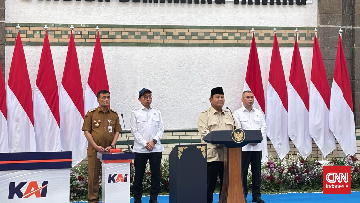
Indonesian President Prabowo Subianto stated that railways must serve all people without exception, acknowledging a dilemma between developing high-speed rail and potentially leaving smaller towns behind.
"Sometimes there is a dilemma, wanting high-speed trains, but in the end, small towns are not served. Yes, we are pursuing modernization, we are pursuing technology, but remember, technology and all facilities are to serve the people. This is a message I convey to Kereta Api Indonesia," Prabowo said at Semarang Tawang Station on Thursday.
Prabowo noted that in many countries, railways are considered a public service, not solely profit-driven. He believes public railway transportation is a vital instrument for growing the Indonesian economy and fostering economic democratization.
He further stated that railways bring broad benefits, especially to low-income individuals, and play a significant role as an economical logistics instrument. Following this, the government plans to develop the Trans-Sumatra Railway, with potential parallel development of the Trans-Kalimantan railway.
Sometimes there is a dilemma, wanting high-speed trains, but in the end, small towns are not served. Yes, we are pursuing modernization, we are pursuing technology, but remember, technology and all facilities are to serve the people. This is a message I convey to Kereta Api Indonesia.
DistantNews Editorial
Originally published by CNN Indonesia in Indonesian. Translated, summarized, and contextualized by our editorial team with added local perspective. Read our editorial standards.
More Stories


From Our Blog

What Gets Lost (and Found) When News Is Translated

The Critical Role of Diaspora Media in Global News

What Travellers Should Know About Countries with Restricted Press

A Digital Nomad's Guide to Following Local News

How the Same Story Looks Different in Different Countries
