

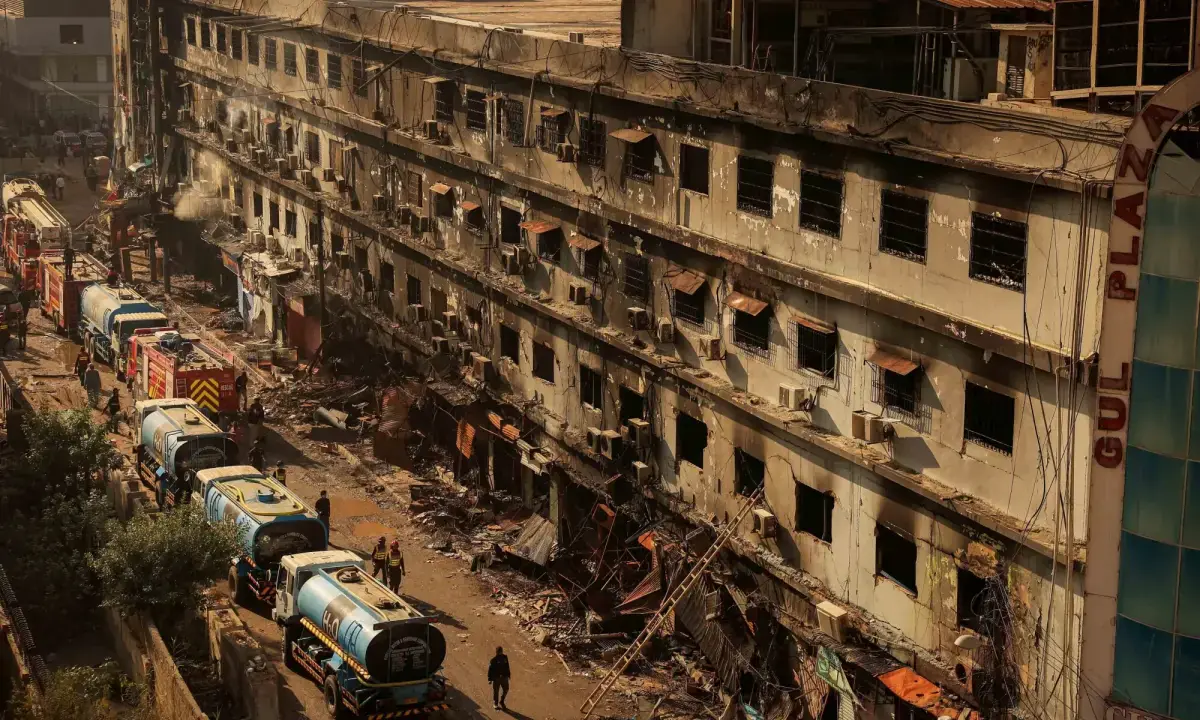
Prosecution seeks inclusion of Gul Plaza inquiry report in charge sheet
Summarized and contextualized by DistantNews.
At a glance
News
Named sources
Under investigation
- Prosecutors have returned the charge sheet for the Gul Plaza case for a third time due to unresolved defects and the failure to include a judicial commission's report.
- The investigating officer (IO) has implicated four union officials and the owner of an artificial flower shop, classifying them as absconders.
- The prosecution insists the IO must rectify issues, including incorporating the judicial commission's findings and clarifying criminal liability, before resubmitting the report.
Prosecutors have once again rejected the charge sheet submitted by the investigating officer in the Gul Plaza case, marking the third time the document has been returned. The prosecution cited the failure to include a crucial judicial commission's report and the persistence of previously identified defects as reasons for the rejection.
The prosecution has once again returned the charge sheet submitted by the investigating officer in the Gul Plaza case, as he failed to include the judicial commission’s report and to remove several defects earlier pointed out by the prosecution.
The investigating officer had attempted to fix responsibility on four union officials, Tanveer Pasta, Amar Ismail, Muhammad Ramazan, and Muhammad Ameen, along with Naimatullah, the owner of an artificial flower shop, and his teenage son. These individuals were listed as absconders under Section 512 of the Criminal Procedure Code. Charges included offenses related to negligent conduct with fire, culpable homicide, and mischief by fire or explosive substance.
Even after six months, the IO failed to provide reasons for the delay in submitting the charge sheet, as well as explain why he did not include the names of officials from the relevant regulatory departments and former union officials who were allegedly involved in the unauthorised construction on the plot.
Despite directives to rectify earlier issues, the IO submitted the charge sheet without addressing them. The prosecution has now instructed the IO to resubmit the report after removing all defects and incorporating the suggestions from the Justice Agha Faisal-led judicial commission's report, which was submitted to the provincial government.
The IO did not include the findings of the joint investigation team or the judicial commission, adding that he also failed to obtain reports from the relevant departments, including the Sindh Building Control Authority, rescue services, and civil defence, to ascertain the structural viability of the building.
A source familiar with the matter revealed that even after six months, the IO has not provided reasons for the delay in submitting the charge sheet. Furthermore, the IO failed to explain why names of officials from regulatory departments and former union officials allegedly involved in unauthorized construction were omitted. The findings of a joint investigation team and the judicial commission were also not included. The IO also neglected to obtain reports from relevant departments, such as the Sindh Building Control Authority, rescue services, and civil defense, to assess the building's structural integrity. Additionally, the IO generalized criminal liability instead of assigning it to each suspect and did not obtain necessary documents related to the plaza.
The IO did not fix criminal liability on each suspect; instead, he generalised the responsibility in the earlier chargesheet, the source said, adding that the IO did not obtain the documents related to the plaza.
DistantNews Editorial
Originally published by Dawn. Summarized and contextualized by our editorial team with added local perspective. Read our editorial standards.
More Stories
From Our Blog

What Gets Lost (and Found) When News Is Translated

The Critical Role of Diaspora Media in Global News

What Travellers Should Know About Countries with Restricted Press

A Digital Nomad's Guide to Following Local News

How the Same Story Looks Different in Different Countries
