


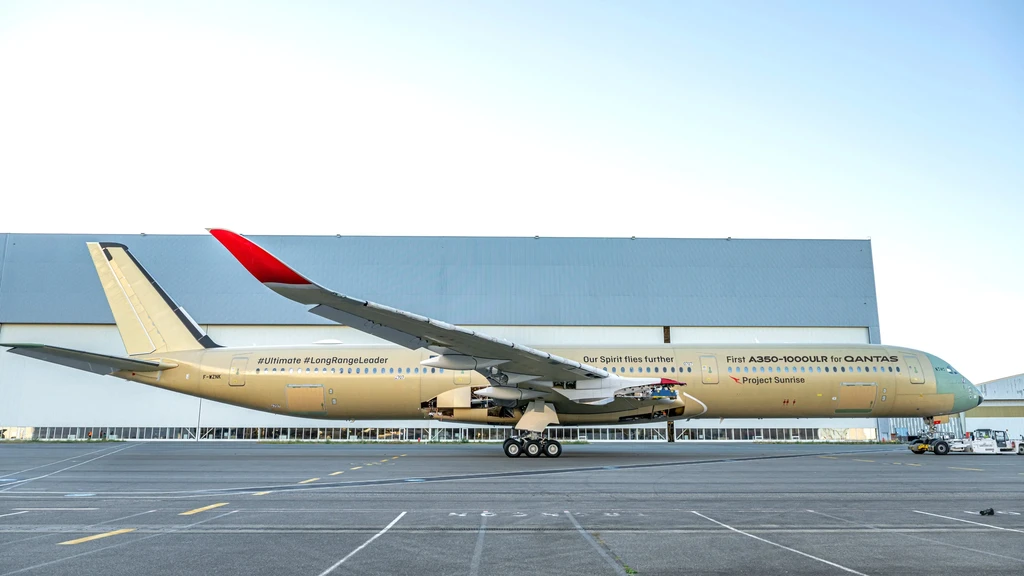
Qantas Prepares for World's Longest Flights: Sydney to London and New York Non-Stop
Translated from Greek, summarized and contextualized by DistantNews.
TLDR
- Qantas is preparing to launch the world's longest commercial flights, connecting Sydney directly with London and New York starting in 2027.
- These flights will last up to 22 hours non-stop, utilizing specially configured Airbus A350-1000ULR aircraft with an extra fuel tank.
- The aircraft's cabin design focuses on passenger well-being, featuring reduced seating, a "wellness zone" for exercise, and scientific studies to mitigate jet lag.
The skies are set to shrink as Australian airline Qantas pioneers a new era of ultra-long-haul travel. Ta Nea reports on Qantas' ambitious plan to launch the world's longest commercial flights by 2027, connecting Sydney directly to London and New York. This groundbreaking initiative promises to redefine air travel, allowing passengers to remain airborne for up to 22 hours without a single stopover.
For decades, the biggest challenge in air transport has been to shorten distances. To arrive faster, with fewer stops and with as much comfort as possible.
This leap into the future of aviation is made possible by the specially designed Airbus A350-1000ULR (Ultra Long Range) aircraft. The key innovation lies in an additional 20,000-liter fuel tank, granting the plane the necessary range to bridge vast continental distances. However, Qantas recognizes that conquering the technical challenge is only half the battle; the human element—enduring such an extended journey—is equally critical.
The new version of the A350-1000 can fly for such a long time thanks to a critical technical change: it has an additional fuel tank in the rear of the aircraft, with a capacity of 20,000 liters.
Qantas has meticulously engineered the cabin experience around passenger comfort and well-being. Unlike standard A350-1000 configurations that carry over 300 passengers, Qantas's planes will accommodate just 238. This deliberate reduction in seating capacity frees up space, prioritizing passenger comfort. A standout feature is the "wellness zone," a dedicated area accessible to all passengers, equipped with exercise aids and guided stretching programs. This space acknowledges the physical and mental toll of prolonged immobility, offering a vital outlet for movement and rejuvenation mid-flight.
But the biggest challenge is not just technical. It is human. How can one spend almost a whole day on a plane without collapsing from fatigue, immobility, and jet lag?
From a Greek perspective, this development signifies a remarkable advancement in global connectivity, potentially making Australia more accessible than ever. While the concept of a 22-hour flight might seem daunting, Qantas's focus on passenger health and comfort suggests a thoughtful approach to mitigating the challenges of extreme jet lag and physical discomfort. This innovation not only pushes the boundaries of aerospace engineering but also prioritizes the human experience, aiming to make the longest journeys as comfortable and manageable as possible.
The logic is that on a 20 or 22-hour journey, passengers cannot remain immobilized in their seats. The ability to get up, move, and do some exercises is considered critical for both comfort and health.
DistantNews Editorial
Originally published by Ta Nea in Greek. Translated, summarized, and contextualized by our editorial team with added local perspective. Read our editorial standards.
More Stories



From Our Blog

What Gets Lost (and Found) When News Is Translated

The Critical Role of Diaspora Media in Global News

What Travellers Should Know About Countries with Restricted Press

A Digital Nomad's Guide to Following Local News

How the Same Story Looks Different in Different Countries
