


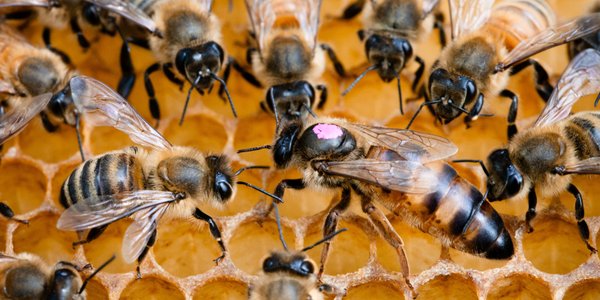
Queen bee origins revealed: 'These insects are capable of environmental engineering'
Translated from Polish, summarized and contextualized by DistantNews.
At a glance
News
Sources not specified
Context piece
- New research suggests that the development of queen bees is determined not just by royal jelly, but also by specialized cells called queen cells.
- These cells, along with controlled temperature, humidity, and unique wax properties, play a crucial role in a larva's transformation into a queen.
- Specialized worker bees, exhibiting physiological changes and maintaining higher temperatures, are responsible for constructing and maintaining these queen cells.
For decades, the prevailing theory held that royal jelly alone dictated whether a bee larva would develop into a queen or a worker. However, new research from the University of California, Riverside, challenges this notion, revealing a more complex process involving specialized "queen cells" and environmental controls.
The old belief that royal jelly alone determines the fate of a larva is incorrect. The development of a queen is a much more complex process.
The study indicates that the transformation into a queen bee is influenced by more than just diet. The construction and maintenance of queen cells, known as 'mateczniki' in Polish, are critical. These cells feature a distinct, elongated shape and are built from a unique type of wax with different properties than that used for worker cells. This specialized wax is less dense, more flexible, and better at retaining heat and moisture, differing in chemical composition as well.
Researchers used thermal imaging, behavioral observations, and material analysis to compare queen cells with standard worker cells. They found that the wax in queen cells had a different chemical makeup, including variations in fatty acids and signaling compounds. To test the hypothesis, larvae were placed in both typical queen cell wax and standard worker wax, with all receiving the same royal jelly diet.
The construction and maintenance of queen cells, including temperature and humidity control, along with the properties of the wax, are crucial factors.
The results showed that only larvae developing in the specialized queen cells successfully transformed into fully developed queens. Those in standard cells either perished or developed into smaller, less viable queens. The study also highlighted that worker bees responsible for these queen cells undergo physiological changes, including maintaining a higher body temperature, which contributes to a warmer environment within the cells, potentially accelerating development.
Specialized worker bees, exhibiting physiological changes and maintaining higher temperatures, are responsible for constructing and maintaining these queen cells.
DistantNews Editorial
Originally published by Rzeczpospolita in Polish. Translated, summarized, and contextualized by our editorial team with added local perspective. Read our editorial standards.
More Stories



From Our Blog

What Gets Lost (and Found) When News Is Translated

The Critical Role of Diaspora Media in Global News

What Travellers Should Know About Countries with Restricted Press

A Digital Nomad's Guide to Following Local News

How the Same Story Looks Different in Different Countries
