


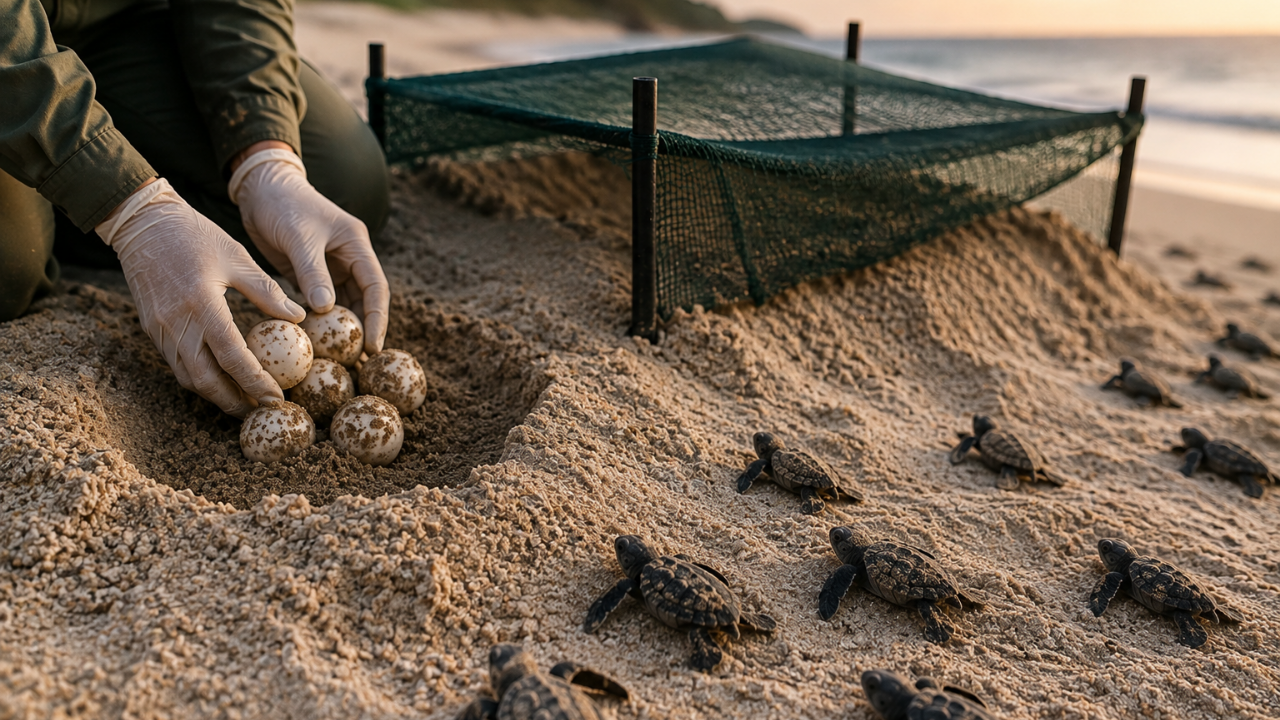
Relocated sea turtle nests yield fewer hatchlings, smaller young, and skewed sex ratios
Translated from English and summarized by DistantNews. Read the original for the full story.
At a glance
News
Sources not specified
Context piece
- Relocating vulnerable sea turtle nests, while preventing immediate loss, can lead to fewer hatchlings and smaller young.
- Warmer nests from relocation significantly skew sex ratios, producing predominantly female hatchlings.
- Conservation efforts need to consider factors beyond temperature, such as artificial shading, to improve hatchling quality and sex balance.
Conservationists often move vulnerable sea turtle nests to safer locations to protect them from immediate threats like high tides, extreme heat, flooding, and erosion. However, a new two-year study suggests this practice may carry unseen consequences that impact more than just the number of eggs that hatch.
relocation may come with consequences that are not always visible when conservation success is measured simply by counting how many eggs hatch.
Researchers studying green turtles on Heron Island, off the coast of Queensland, Australia, found that relocated nests produced fewer hatchlings. Those that did emerge were often smaller and performed less well than hatchlings from nests left in their natural locations. The study, published in the journal Marine Biology, highlights the complexity of recreating a natural nesting environment.
A significant finding relates to sex determination in sea turtles, which is dependent on incubation temperature. Warmer nests typically produce more females, while cooler conditions yield more males. The study revealed that unshaded relocated nests were warmer, especially during late incubation. In one nesting season, this resulted in an estimated sex ratio with only 8% of sampled hatchlings being male.
warmer relocated nests could dramatically skew the sex ratio, with only an estimated 8% of sampled hatchlings being male during one nesting season.
While shading helped reduce nest temperatures and led to a more balanced sex ratio, the research underscores the need for conservationists to carefully consider various environmental factors beyond just temperature when relocating nests. The goal is to ensure the successful recovery of turtle populations by improving hatchling quality and achieving a healthier sex balance.
artificial shade could be useful when conservationists are trying to prevent nests from overheating.
About this summary
Originally published by Times of India in English. Translated, summarized, and contextualized automatically by DistantNews, with a note on how the source frames the story. Not individually reviewed before publishing. How this works.
More Stories


From Our Blog

What Press Freedom Means for the News You Read

What Gets Lost (and Found) When News Is Translated

The Critical Role of Diaspora Media in Global News

What Travellers Should Know About Countries with Restricted Press

A Digital Nomad's Guide to Following Local News
