


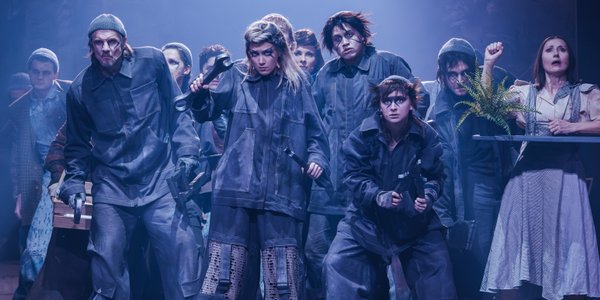
"Rewolta": Maanam's music fuels Poznań's rebellion against authorities in new musical
Translated from Polish, summarized and contextualized by DistantNews.
At a glance
In-depth
Sources not specified
Context piece
- The musical "Rewolta" at the Musical Theatre in Poznań dramatizes the 1956 Poznań Uprising, focusing on the emotional desperation of citizens protesting poor living conditions.
- The play depicts 58 ordinary people killed by military and police fire during the protests.
- It uses the story of two brothers, one aligned with the new government and the other disillusioned, to explore the complexities of the events.
A new musical, "Rewolta," at the Musical Theatre in Poznań, brings to life the 1956 Poznań Uprising, a pivotal but often overshadowed event in Polish history. The production focuses on the emotional turmoil and desperation of tens of thousands of Poznań residents who took to the streets to protest worsening living conditions. The play starkly portrays the tragic outcome: 58 random individuals lost their lives to gunfire from military and police forces.
Directed by Przemysław Kieliszewski, "Rewolta" does not aim for a precise historical reconstruction. Instead, it draws on fragments of the events, emphasizing the raw emotions of the citizens. The narrative is anchored by the fictionalized lives of two Poznań brothers. Franek, a former teacher, struggles to find work in his profession and ends up as an unskilled laborer due to his past beliefs. His younger brother, Mietek, initially embraces the new government's promises of a better world. Their differing paths place them on opposite sides during the June 1956 protests, highlighting the era's complex and often morally ambiguous landscape.
The play also features a collective character representing the "szczuny," a group of Poznań youths who, through their presence on the streets, become keen observers of human emotions and the unfolding events. They serve as narrators of the city's story, reflecting the broader societal dynamics. The production uses the iconic song "Stoję, stoję, czuję się świetnie" (I stand, I stand, I feel great) by Maanam, with lyrics by Kora and music by Marek Jackowski, to set an ironic tone. In the play, Anna Lasota, costumed as Death, sings the lyrics, foreshadowing the tragic violence to come.
DistantNews Editorial
Originally published by Rzeczpospolita in Polish. Translated, summarized, and contextualized by our editorial team with added local perspective. Read our editorial standards.
More Stories

From Our Blog

What Gets Lost (and Found) When News Is Translated

The Critical Role of Diaspora Media in Global News

What Travellers Should Know About Countries with Restricted Press

A Digital Nomad's Guide to Following Local News

How the Same Story Looks Different in Different Countries
