


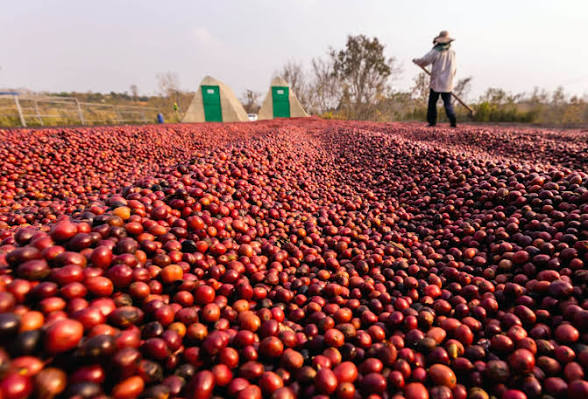
Robusta coffee prices rise in Cameroon's production areas
Translated from French, summarized and contextualized by DistantNews.
At a glance
News
Documents & data
Context piece
- The price of robusta coffee has increased in Cameroon's main production areas after months of stability.
- Producers are benefiting from the price rise, though rates remain below early-year levels.
- The price increase could help improve coffee farmers' incomes amid efforts to revive the sector.
The price of robusta coffee is rising again in Cameroon's key production zones, marking a positive turn for producers after several months of stability. Data from the National Cocoa and Coffee Board's (ONCC) Information System indicates that robusta beans were trading between 1,275 and 1,400 CFA francs per kilogram as of June 16, 2026. This represents an increase of 75 to 100 CFA francs per kilogram compared to the previous three months, when prices hovered between 1,200 and 1,300 CFA francs.
While this price recovery is seen as a positive signal by industry stakeholders, it has not yet reached the levels seen at the beginning of the year. In March 2026, robusta coffee briefly outperformed cocoa on the national market, a rare occurrence that had boosted producer optimism. However, this advantage was short-lived, as cocoa prices resumed their upward trend from mid-March.
Currently, cocoa beans are approaching the 2,000 CFA francs per kilogram mark, reinforcing its position as the dominant export crop. Despite the gap between robusta and cocoa prices, the recent gains for robusta could significantly contribute to the income of coffee farmers. This comes at a crucial time as Cameroon seeks to revitalize its coffee sector for sustainable growth.
The ONCC data highlights the fluctuating nature of commodity markets and the ongoing efforts to support agricultural producers in the region. The sustained efforts to revive the coffee sector aim to ensure better livelihoods for farmers and contribute to the national economy.
DistantNews Editorial
Originally published by Journal du Cameroun in French. Translated, summarized, and contextualized by our editorial team with added local perspective. Read our editorial standards.
More Stories



From Our Blog

What Gets Lost (and Found) When News Is Translated

The Critical Role of Diaspora Media in Global News

What Travellers Should Know About Countries with Restricted Press

A Digital Nomad's Guide to Following Local News

How the Same Story Looks Different in Different Countries
