

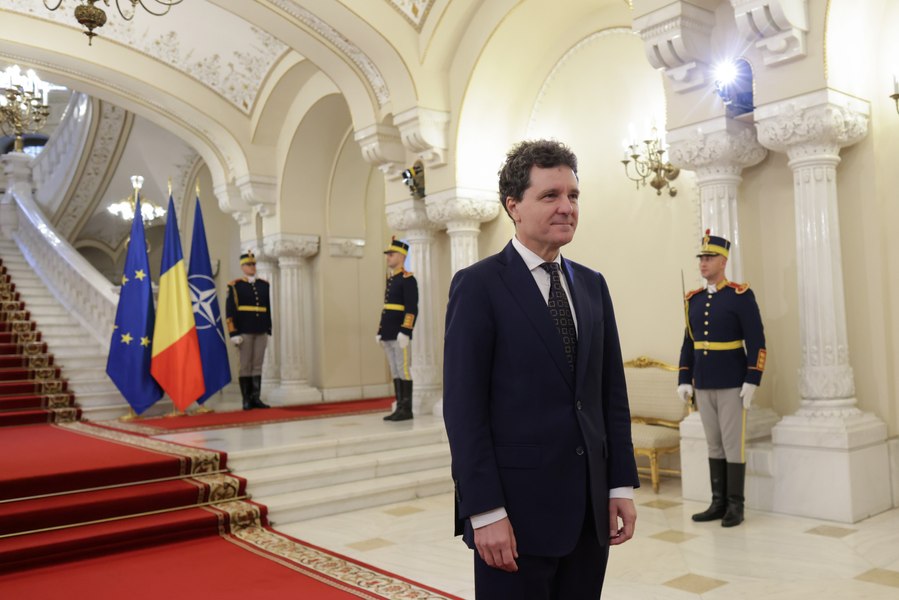

Romanian Rector Criticizes Opaque Premier Selection Process
Translated from Romanian and summarized by DistantNews. Read the original for the full story.
At a glance
Analysis
Named sources
Context piece
- A Romanian university rector, Remus Pricopie, criticized the opaque process of selecting a new prime minister.
- He argued that government formation should follow constitutional principles and a clear political logic, not personal preference.
- Pricopie stressed the need for public understanding of the rationale behind the chosen candidate.
Remus Pricopie, rector of the National School of Political and Administrative Studies (SNSPA), has voiced concerns over the behind-the-scenes negotiations determining Romania's next prime minister. He argues that the process lacks transparency and a coherent political rationale, moving beyond mere personal preference.
Politics is not mathematics, but negotiation. However, there is something equally important: a coherent model of thinking, applied to the concrete situation, which explains why a certain option is considered more suitable than another. And this matters. People don't just want to know who the prime minister will be. They want to understand why that name and not another.
Pricopie stated that while there's no "magic formula" for selecting a premier, politics requires a consistent thought model applied to concrete situations. He believes the public needs to understand *why* a particular candidate is chosen, not just *who* it will be. This understanding is crucial for public acceptance, even if not full agreement.
He recalled past government formations, like the "Nicu and Marcel" era and the 2025 government led by Ilie Bolojan, noting they had clear justifications. These included shared governance by major party leaders based on political balance or a pro-European coalition aimed at institutional stability and countering extremist forces. Pricopie suggested these arrangements, despite potential political disagreements, offered a coherent explanation for the government's architecture and strategic objectives.
In the period of the 'Nicu and Marcel' formula, regardless of whether some agreed with the names of the two leaders, there was still a clear justification: the leaders of the two main parties jointly assumed governance, in a coalition formula built on a 50%-50% political balance, until the elections. There was a logic of representation and shared responsibility.
Following the recent rupture of the coalition agreement between PSD, PNL, USR, UDMR, and minority groups, Pricopie questions the logic guiding the formation of the new government. He asserts that the profile of the future prime minister fundamentally depends on the chosen strategy. A premier with independent authority and external credibility requires different criteria than a political leader whose selection hinges on parliamentary strength, negotiation skills, and electoral legitimacy. Without a clear, explicit logic for political and institutional construction, Pricopie warns of the risk of public alienation.
The problem is not just the name of the future prime minister. The problem is whether there is a clear model of political and institutional construction that citizens can understand, analyze, and possibly accept – even if they do not agree with all the details.
About this summary
Originally published by Adevărul in Romanian. Translated, summarized, and contextualized automatically by DistantNews, with a note on how the source frames the story. Not individually reviewed before publishing. How this works.
More Stories
From Our Blog

News in Translation: What Gets Lost, and How We Keep the Framing

Diaspora Media: How Communities Abroad Follow Home

Traveling Where the Press Is Not Free: How to Read the News There

The Digital Nomad's Guide to Local News

The Same Story, Different Countries: How Coverage Changes at the Border
